The Raleigh Naturalist

June 30, 2008

Here we are – I hope you’re with me!

Filed under: About & reflection — raleighnaturalist @ 12:02 am

I hope all my old readers don’t get lost in the Internet woods, but Raleigh Nature has moved to this site on WordPress.com.  While I was in the mountains, a virus squatted on my old site and we had to close it.  I will be ironing out details for some time, but almost all the posts are restored here.  My sincere apologies to anyone who was inconvenienced by the old site’s bug.  Back at you soon.  Please spread the word.

June 29, 2008

Ranging the Piedmont

Filed under: About & reflection, Exotica, Nature Lore — Tags: , , — raleighnaturalist @ 11:20 pm

This post was originally published on June 21, 2008

Haven’t posted, haven’t been on the greenway. Been furiously finishing up my school year, doing some arts writing, and starting a new personal blog. And now I’m off for 5 days to the mountains. Doing a big environmental education workshop at the Pisgah Forest Institute in Brevard. Once I get back, I’ll be posting more often.

On my way to the mountains, I will traverse this widest section of the eastern U.S. Piedmont, which stretches 225 miles from Raleigh to the scarp of the Blue Ridge Mountains. At Morganton, I will travel just north of the South Mountains, which are significant, “real” mountains but not part of the Blue Ridge system at all. They are monadnocks, outcrops of rock even more ancient than the Appalachians, which have withstood the millions of years of erosion and flattening that produced the Piedmont. They look decidedly odd in the midst of the Piedmont’s gentle swells, as I hope you will get some idea of, below.

These are from south of the South Mountains, off the 64 route rather than 40. Below is the development just beginning within sight of this peak. My drive on State Road 10 and 64 reminded me that it is not just near the big cities that Piedmont vistas are filling up with homes and shopping centers.

Below is a scene from South Mountain State Park, which was closed due to being completely filled the Memorial Day Monday I went. Another trip we will explore the unique granite faces associated with these Piedmont mountains.

***************

The Continental Divide at Interstate 40

After the South Mountains, I will drive through the Piedmont watershed of the Catawba River, then begin the climb up to the valley of the Swannanoah River, which runs from Black Mountain to Asheville. At Ridgecrest, I will cross the Continental Divide. Water falling to the east goes to the Catawba and eventually to the Atlantic Ocean. Water falling west of the crest will go north via the French Broad, find the Little Tennessee, and eventually flow into the Gulf of Mexico. As a child at Camp Ridgecrest, a summer facility of the Baptist Conference there, I learned this fact standing on a mountain ridge, where we were invited to spit in alternate directions and imagine the geographic adventures of our saliva. It was, truly, an unforgettable moment, and one of many that shaped me into a naturalist.

The state-published geological guide to Interstate 40, using mileposts, instructs you to look at this dark rock at the top of the incline, which is part of the Blue Ridge, and compare it to the lighter rockfaces in the roadcuts at the botttom. I tried – safely – but pictures of those lighter rocks will have to wait for a safer scenario than Memorial Day weekend!

I’ll see you again before July 4th! Have a great one!


Hot Spring Critter Sightings!

Filed under: Central Raleigh, Greenways & Parks, Nature Lore — Tags: , , , , , — raleighnaturalist @ 11:12 pm

This post was originally published in May 2008

This owl swooped down and landed on a branch directly above Crabtree Creek as I walked on the high greenway that traverses a steep hill off Capital Boulevard.  This is just east of the sad section that has recently had its woody buffer appropriated by bulldozers.

 It sat there for the 20 minutes or so I watched it from different angles.  I believe it’s a Barn Owl.  This was about half hour before dusk.  The owl was getting ready for work.

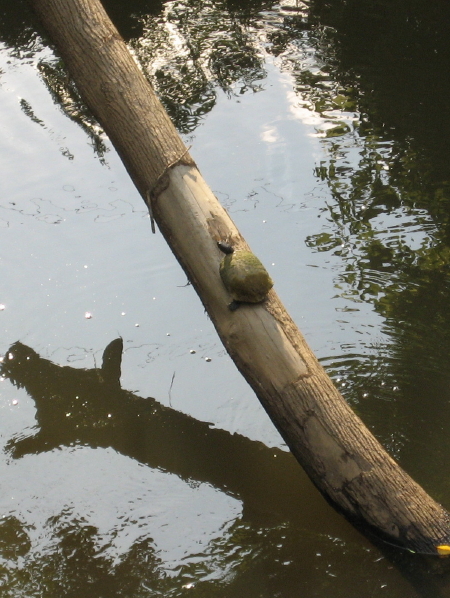
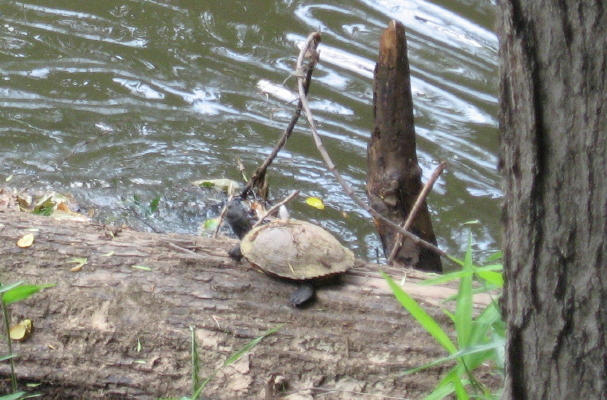
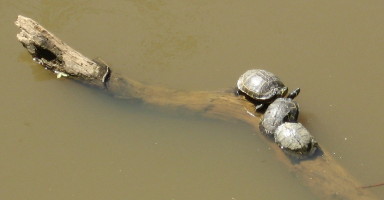
The owl is somewhere in the scene below.  Crabtree takes a sharp bend as it approaches Capital Boulevard near the beltline.  It is turned by a large rock outcrop that underlies the hill on which a large former car dealership resides, framed by the south ramp off the beltline.  The slope from the back of the car dealership down to the creek is some really interesting terrain, and the troublesome but dramatic walkway that clings to the hillside is one of my favorite stretches in the whole system. One reason being it’s a great place to spot turtles, as you will see below. (snapper story below that)

Below is the rock that turns Crabtree.  It looks dark and foliated, but it’s drenched in algae, so Iwon’t make a specific guess.


 ***********

Snapper Lays Eggs

The family of one of my students had a female snapping turtle crawl up into a sandy area near their backyard creek and lay some eggs.  She finished and went on  back to the creek, and now they get to watch for babies.  Good luck to Carson and her family!


Nature news around the town

Filed under: About & reflection, Greenways & Parks, Nature Lore, North Raleigh — Tags: — raleighnaturalist @ 10:57 pm

This post was originally published on May 18, 2008

The Wakefield Ecology Club

I made my first public appearance as The Raleigh Naturalist by presenting to the Ecology Club at Wakefield Middle School! I took my naturing vest, bursting with loupes, dissection kits, pocket guides and other paraphernalia. I took my naturing briefcase, more of a suitcase with topography maps, geology binder, park guides and my hand-built tree scrapbook. I also had my camera bag and hat. I gave a show and tell with all of that and talked to them about founding an Ecology Club at Enloe and also about my daughter Lily’s Envirothon work there (much more recently!).

This is my walking cabinet of nature resources. I am mostly done color coding the watersheds on the large map. The vest weighs 13 pounds.

The Wakefield Ecology Club was a great group of kids, led by Ms. Cindy Bowling, who invited me. They meet each week and perform recycling chores at Wakefield, plus try to learn more about their environment from guests. They knew lots of great stuff about conservation, invasive species, and native wildlife. We played a quiz game and I rewarded them with conservation goody packets put together by Lily last summer as a service project. All of the students showed excellent interest in the issues. The Wakefield MS campus is lovely. Below are some nature images from their campus.

These blackberries will taste good soon! Below is a rockfall with some really nifty “man-made conglomerate” – some nice high-iron stone encased in concrete.

******************

More Nature News

The News and Observer just teemed with good nature news this week. Durant Park has become a part of the Piedmont Birder’s Trail. Repairs have finally been completed on the section of Greenway between Capital Boulevard and Atlantic Avenue. This stretch of greenway was also featured in a “best greenways” survey by Joe Miller. Links below.

Piedmont Bird Trail

Middle Crabtree Greenway opens!

Favorite Greenways

Triangle Greenways Guide


Maple Sequence and Snapper Loose!

Filed under: Nature Lore, turtles — Tags: , , — raleighnaturalist @ 10:46 pm

This post was originally published May 4, 2008.

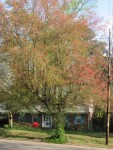
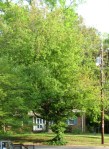
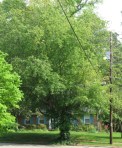
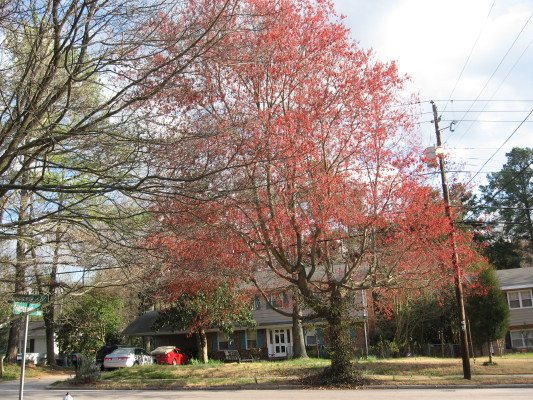
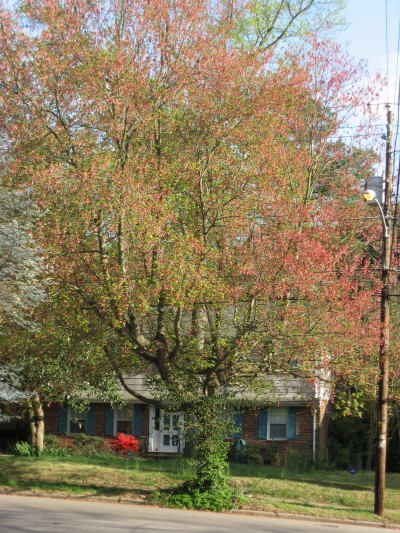
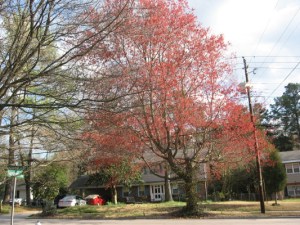
Check this out.  I have been watching this particular red maple on Hardison Drive in Quail Hollow all spring.  What amazing red color from the early samsaras, which emerge and mature before the first spring leaves.  Cool shift through orange as the helicopter seeds slowly lose out to the foliage.
                 

***************** 

Snapper Loose!

 So last week my high school teacher assistant, Randall, a senior helping with my 6th grade science class, brings in a turtle.  Except this turtle made my day, entertained almost my entire school population, and impressed the heck out of us all.  He was huge!  For a 6th grade classroom, anyway.  My students of all ages were in awe as I lifted him from the back and displayed the gaping, snapping mouth and long sharp claws.  By day’s end I had little claw marks all over my hands. On the other hand, this snapper was weary and disgusted.  I promised Randall I would find a nice spot to release him. (Randall had hooked him by the leg with a casting line and hauled him out of the lake in his backyard, where he certainly was not expected back). I though of Blue Jay Point, where I have released ailing box turtles and morose sliders.  I thought of Lassiter Mill, where I have seen, just as I mentioned in the recent post on that subject, animal control officers release unwanted specimens.  This was a big, dangerous turtle ( though they do get over twice this size), and I decided I wanted an undeveloped stretch of water.  Crabtree on the east end of Buckeye Trail was the obvious solution.  Snapper could climb up the bank into the Marsh Creek marsh by Yonkers Road, or float on down to Anderson Point and find the Neuse River, with lots of side choices along the way.

So I wrestled him back into his tub one last time and drove to Milburnie Road and parked.  As I got out, a small peculiar lady with four young children came ambling down the road.  I spoke to them and explained I was a science teacher who could share something interesting if they had a minute.  The kids were appropriately aghast and entertained, but Mom had other ideas.

” You don’t mean you going to turn that turtle loose!  You can give that turtle to me.  I’d love to have it.”

Now even if it wouldn’t have been crazy to give a strong, heavy, dangerous reptile to a small woman with four small kids, I knew exactly why she wanted it, and I was having no part of it.

“You just want to cook this turtle!  I’m going to turn it loose like I promised Randall.”

 And the woman just wouldn’t let go of the idea that I might give her this turtle.  She wanted it badly.  She and her kids watched as I started off down the greenway, lugging the tub.  They started on down Milburnie, but were clearly watching through the trees.  So rather than turning him loose in the small tributary right next to Milburnie, as I had planned, I heaved and puffed with the tub all the way down to Crabtree.  I set him on the grass and took these photos.  Then I slid him down the bank and took the video linked below.

I was right proud of myself as a Baby Boomer teacher who has embraced the 21st century, because I was able to show my students ( and especially Randall) this video post on Pecans & Mistletoe, my nature projects blog, the very next day.  They didn’t have to trust my account, they could watch this turtle go into Crabtree.  Hope you enjoy it as well.

 Snapper Loose! video

Lassiter Mill and Raleigh mill history

I remember the day whenI found out they would eventually close Lassiter Mill bridge. It was old time rickety but somehow made it to modern Raleigh – the 1970s- before being closed and then destroyed in 1984. I had conscientiously driven my 68 VW carefully over the twin tracks several times, fully aware I was testing out a soon-to-be piece of history. The iron on the right is part of the original bridge structure – iron and wood, and a thing of beauty it was. That bridge gave off an air of classic American architecture of a century past, and was fun to drive across as well, following old Lassiter Mill Road off of the new one.

***********

The site was originally called the “Great Falls of Crabtree” and was used by successive mills starting about 1780, a decade before Raleigh’s creation. Cornelius Lassiter purchased it in 1908 and built two 40-horse turbine wheels to mill grain and lumber. It burned in 1959, but the family continued to make use of the property until current times.

Well-heeled homes now surround the entire site, but the area south of dam and lower pool, and downstream to (the new) Lassiter Mill Road, constitutes a small city park. There are picnic tables, a canoe put-in, and truly fine fishing – I have watched fly fisherman work below and above the dam many times. This is the spot where the city animal control folks bring misplaced snapping turtles for release – I’ve seen them wrestle some real monsters out of their truck. The fishing is also perfect for young ones, as my own can attest. Dorian’s first small-mouth bass came from just below the tailrace, and he had the enormous satisfaction, not only of helping to clean, cook, and eat it, but make his sister sick to her stomach as well. Below is his lucky fishing hole.

You can also put a boat in very easily just off the cul-de-sac, and paddle your way as far upstream toward Crabtree Valley as the downed trees and water levels will let you. The deep water above the dam is like a linear lake right through the backyards of million dollar homes. As the water get shallower, you start to see some really nice slate deposits on the banks and realize you have climbed out of East Raleigh’s muddy ditch sections of Crabtree and gotten into some cool Raleigh Belt geology. This reminds us that Lassiter Mill literally and precisely marks the Fall Line in central Raleigh. I’ll run pictures of that trip this summer.

This is the deep water above the dam. Dams like Lassiter Mill present a problem for migrating fish and the mussels dependent on them for reproduction (a long story we’ll get into sometime). Someday we may make an ecological choice to remove the dam. I will miss the easy canoe trip, but I understand the value of unencumbered stretches of water. Amazing to think of all the gristmills (and dams) that used to dot the Raleigh area – road names alone give you some idea – Lassiter, Edwards, Yates, Ligon, etc. A future gem of a post will explore the remains of the small mill still visible in Fallon Park. We used to live closer to nature – but we also exploited nature in ways we have given up.

The comments below represent well the amazing memories and feelings the Raleigh community has for this spot. those comments are a major feature of the newly published book based on this blog.

The Natural History of Raleigh

Older Posts »

Create a free website or blog at WordPress.com.