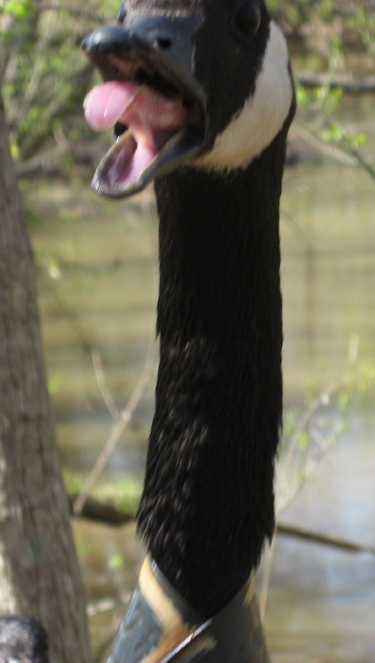
Branta canadensis (apparently with research collar?)
Canada Geese love Raleigh, but we’re not alone. Over half a million of these birds inhabit the East Coast of the U.S., and their role as nuisance wildlife in urban and other developed areas is gaining increasing attention. The first thing I learned in my research is that there are two separate populations of migrating and residential geese. Below is the information.
 Three distinct populations of Canada geese can be found in North Carolina at various times of the year. Two groups are migratory and are found in North Carolina only during the fall and winter. The Atlantic population breeds in Northern Quebec and winters in the northeastern part of the state. The Southern James Bay population breeds in Ontario and can be found widely scattered in the upper coastal plain, piedmont, and foothills. Both migratory populations are declining in number. Conversely, our resident population is increasing and stays in North Carolina year round. Resident geese are found throughout the state with the largest numbers occurring in the piedmont and northeastern part of the state.

As migratory waterfowl and powerful long distance fliers, Canada Geese are beautiful.To many a small child they are rude and aggressive long-necked monsters. Myself, I’ve always thought they looked very much like excellent savings accounts for the post-apocalypse. As the producers of one to three pounds of waste matter EACH, DAILY, they present a water pollution issue.
Here’s Scott Payne in NandO:
Scott Payne, Raleigh’s recreation superintendent for operations, has done the math. He said an adult goose can produce between one and three pounds of droppings a day.
“You put that in a concentrated area — 20 to 30 in one location — you’ve got yourself a mess.”
So where do they all come from? The Humane Society has an interesting theory: that scientists saving the nearly extinct species raised in the 60’s a unique population that was born in captivity and acclimated to society – and its free lunch for geese.

Geese in our local waterways seem to fit in quite well and present scenic views of gosling-raising. But in shopping centers, golf courses and suburban commons, they are an unwelcome intrusion from the natural world whose territory we inexorably diminish each year. (pertinent comment here)
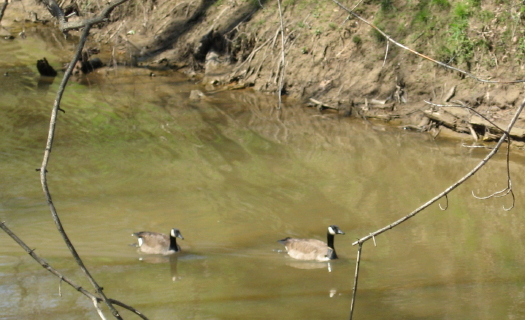
Canada Geese on Crabtree
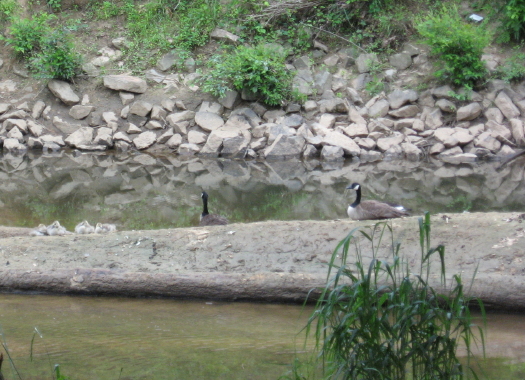
young goslings on Crabtree sandbar at Capital Boulevard
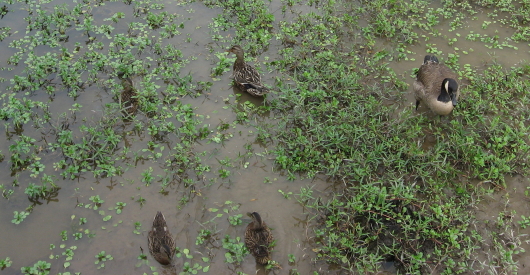
Learning to hunt at Raleigh Swamp
In case you really want to find out more:
Goose Poop(loads pdf)


 raleighnaturalist
 The Raleigh Naturalist