The Raleigh Naturalist

June 29, 2008

Hot Spring Critter Sightings!

Filed under: Central Raleigh, Greenways & Parks, Nature Lore — Tags: , , , , , — raleighnaturalist @ 11:12 pm

This post was originally published in May 2008

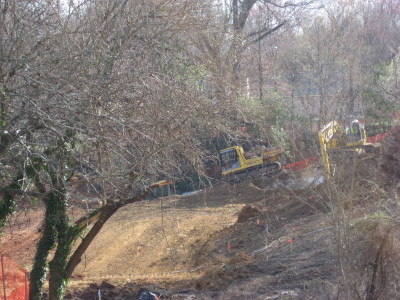
This owl swooped down and landed on a branch directly above Crabtree Creek as I walked on the high greenway that traverses a steep hill off Capital Boulevard.  This is just east of the sad section that has recently had its woody buffer appropriated by bulldozers.

 It sat there for the 20 minutes or so I watched it from different angles.  I believe it’s a Barn Owl.  This was about half hour before dusk.  The owl was getting ready for work.

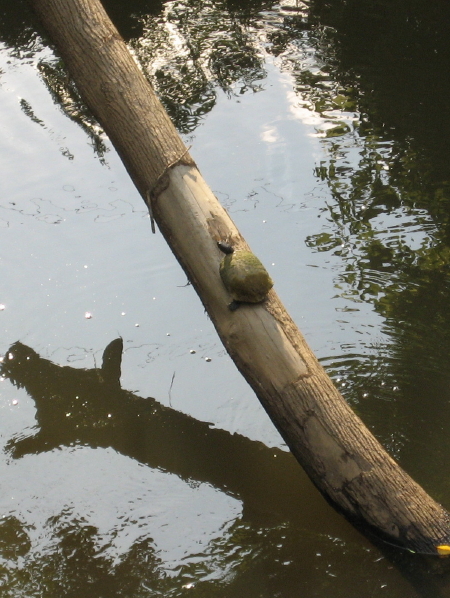
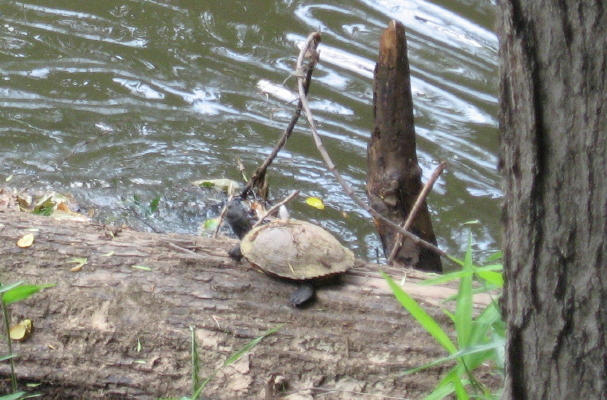
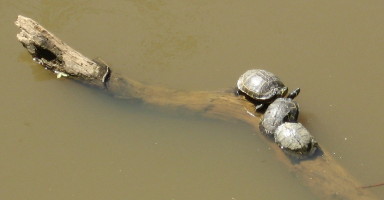
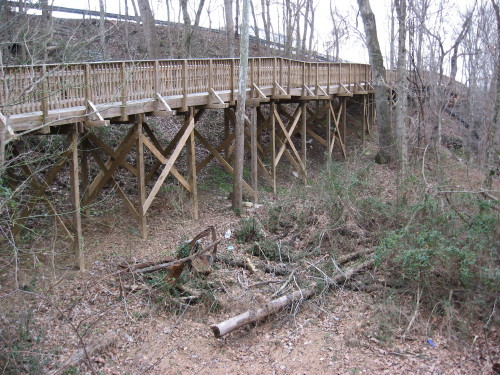
The owl is somewhere in the scene below.  Crabtree takes a sharp bend as it approaches Capital Boulevard near the beltline.  It is turned by a large rock outcrop that underlies the hill on which a large former car dealership resides, framed by the south ramp off the beltline.  The slope from the back of the car dealership down to the creek is some really interesting terrain, and the troublesome but dramatic walkway that clings to the hillside is one of my favorite stretches in the whole system. One reason being it’s a great place to spot turtles, as you will see below. (snapper story below that)

Below is the rock that turns Crabtree.  It looks dark and foliated, but it’s drenched in algae, so Iwon’t make a specific guess.


 ***********

Snapper Lays Eggs

The family of one of my students had a female snapping turtle crawl up into a sandy area near their backyard creek and lay some eggs.  She finished and went on  back to the creek, and now they get to watch for babies.  Good luck to Carson and her family!


Nature news around the town

Filed under: About & reflection, Greenways & Parks, Nature Lore, North Raleigh — Tags: — raleighnaturalist @ 10:57 pm

This post was originally published on May 18, 2008

The Wakefield Ecology Club

I made my first public appearance as The Raleigh Naturalist by presenting to the Ecology Club at Wakefield Middle School! I took my naturing vest, bursting with loupes, dissection kits, pocket guides and other paraphernalia. I took my naturing briefcase, more of a suitcase with topography maps, geology binder, park guides and my hand-built tree scrapbook. I also had my camera bag and hat. I gave a show and tell with all of that and talked to them about founding an Ecology Club at Enloe and also about my daughter Lily’s Envirothon work there (much more recently!).

This is my walking cabinet of nature resources. I am mostly done color coding the watersheds on the large map. The vest weighs 13 pounds.

The Wakefield Ecology Club was a great group of kids, led by Ms. Cindy Bowling, who invited me. They meet each week and perform recycling chores at Wakefield, plus try to learn more about their environment from guests. They knew lots of great stuff about conservation, invasive species, and native wildlife. We played a quiz game and I rewarded them with conservation goody packets put together by Lily last summer as a service project. All of the students showed excellent interest in the issues. The Wakefield MS campus is lovely. Below are some nature images from their campus.

These blackberries will taste good soon! Below is a rockfall with some really nifty “man-made conglomerate” – some nice high-iron stone encased in concrete.

******************

More Nature News

The News and Observer just teemed with good nature news this week. Durant Park has become a part of the Piedmont Birder’s Trail. Repairs have finally been completed on the section of Greenway between Capital Boulevard and Atlantic Avenue. This stretch of greenway was also featured in a “best greenways” survey by Joe Miller. Links below.

Piedmont Bird Trail

Middle Crabtree Greenway opens!

Favorite Greenways

Triangle Greenways Guide


Lassiter Mill and Raleigh mill history

I remember the day whenI found out they would eventually close Lassiter Mill bridge. It was old time rickety but somehow made it to modern Raleigh – the 1970s- before being closed and then destroyed in 1984. I had conscientiously driven my 68 VW carefully over the twin tracks several times, fully aware I was testing out a soon-to-be piece of history. The iron on the right is part of the original bridge structure – iron and wood, and a thing of beauty it was. That bridge gave off an air of classic American architecture of a century past, and was fun to drive across as well, following old Lassiter Mill Road off of the new one.

***********

The site was originally called the “Great Falls of Crabtree” and was used by successive mills starting about 1780, a decade before Raleigh’s creation. Cornelius Lassiter purchased it in 1908 and built two 40-horse turbine wheels to mill grain and lumber. It burned in 1959, but the family continued to make use of the property until current times.

Well-heeled homes now surround the entire site, but the area south of dam and lower pool, and downstream to (the new) Lassiter Mill Road, constitutes a small city park. There are picnic tables, a canoe put-in, and truly fine fishing – I have watched fly fisherman work below and above the dam many times. This is the spot where the city animal control folks bring misplaced snapping turtles for release – I’ve seen them wrestle some real monsters out of their truck. The fishing is also perfect for young ones, as my own can attest. Dorian’s first small-mouth bass came from just below the tailrace, and he had the enormous satisfaction, not only of helping to clean, cook, and eat it, but make his sister sick to her stomach as well. Below is his lucky fishing hole.

You can also put a boat in very easily just off the cul-de-sac, and paddle your way as far upstream toward Crabtree Valley as the downed trees and water levels will let you. The deep water above the dam is like a linear lake right through the backyards of million dollar homes. As the water get shallower, you start to see some really nice slate deposits on the banks and realize you have climbed out of East Raleigh’s muddy ditch sections of Crabtree and gotten into some cool Raleigh Belt geology. This reminds us that Lassiter Mill literally and precisely marks the Fall Line in central Raleigh. I’ll run pictures of that trip this summer.

This is the deep water above the dam. Dams like Lassiter Mill present a problem for migrating fish and the mussels dependent on them for reproduction (a long story we’ll get into sometime). Someday we may make an ecological choice to remove the dam. I will miss the easy canoe trip, but I understand the value of unencumbered stretches of water. Amazing to think of all the gristmills (and dams) that used to dot the Raleigh area – road names alone give you some idea – Lassiter, Edwards, Yates, Ligon, etc. A future gem of a post will explore the remains of the small mill still visible in Fallon Park. We used to live closer to nature – but we also exploited nature in ways we have given up.

The comments below represent well the amazing memories and feelings the Raleigh community has for this spot. those comments are a major feature of the newly published book based on this blog.

The Natural History of Raleigh

Spring Forward – erase your nature deficit!

This post was originally published on March 23, 2008.

The equinox on Thursday and the warm weather have us all thinking about getting out into the dirt – right?  Maybe your kid doesn’t like to get out and garden with you.  Consider sending them to the Green River Preserve this summer.  This environmental camp for rising second through ninth graders, with expedition programs for all high schoolers, is located on several thousand acres in the Blue Ridge Mountains.  They have an outstanding program.  They also promote a book, Last Child in the Woods, by Richard Louv, which centers on a concept to consider: nature-deficit disorder, which can affect any of us if we’re not careful.  Plant those seeds, take that walk, mount that expedition!  Have a great one!

 The flowery driveway of a street that edges Fletcher Park. This time of year, it’s one of the prettiest sights in central Raleigh. You can glimpse the new construction on the right.  More about that below.


The Fletcher water garden project is really moving along and needs more coverage. One of the primary functions of the water garden will be to capture, slow and filter the water from this drainage as it makes its way down to Pigeon House Creek, across the railroad tracks by Capital Boulevard.  There are plenty of other tributaries to that troubled creek that need help more than this heavily wooded glen, but it definitely will provide some much-needed quality control.  We will watch this project carefully, and use it as an entrance to the many issues surrounding Pigeon House Creek.

Fletcher Park’s new project

Filed under: Central Raleigh, Greenways & Parks, Nature Lore — Tags: — raleighnaturalist @ 9:22 pm

This post was originally published on March 19, 2008

As well described at New Raleigh, a new water garden has been approved for Fletcher Park. This controlled, even manicured, piece of urban wilderness was a Methodist orphanage most of my childhood. Now it is a heavily used recreational area with a friendly hillside picnic area and a gorgeous, richly planted plateau overlooking a really intriguing amphitheatre. The south edge used to be more or less thickly shrubbed and ignored, but now the environmental model project will dress up and bestow structured access to that area. For now, it’s a mess, but it sounds nifty.

Above, the flowering trees of the plateau and the amphitheatre. Below are two wonderful tree specimens that are nearby. Last are two pictures of the water garden construction.

Above a red oak, below a white.

Fletcher water garden site

Bikes Trails RIP – highlights greenway loss

Filed under: Central Raleigh, Crabtree Creek, Greenways & Parks, North Raleigh, waterways — Tags: , , — raleighnaturalist @ 9:08 pm

This post was originally posted on March 6, 2008.


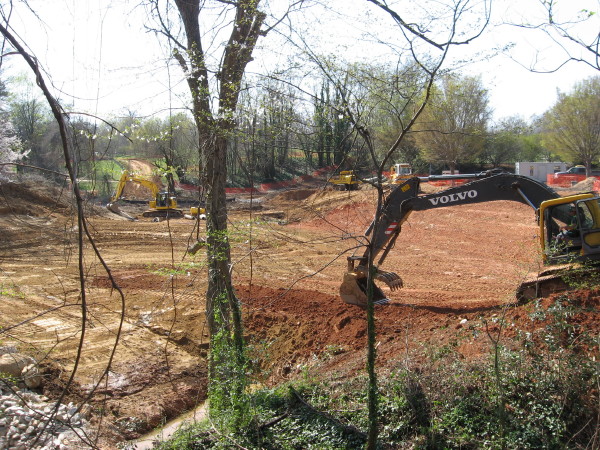
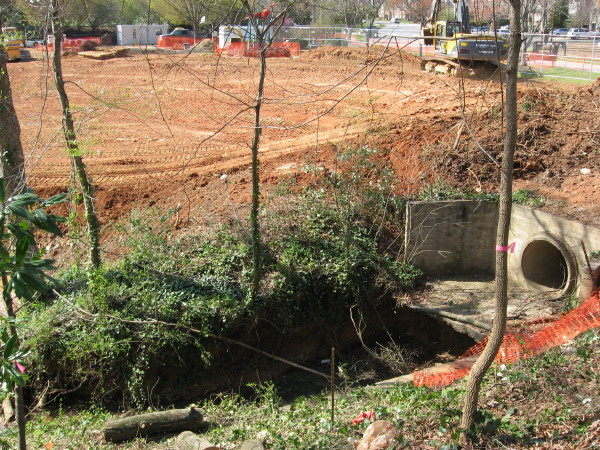
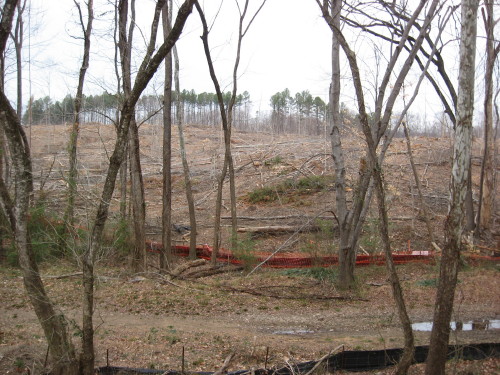
The destruction of the bike trails described by Joe Miller is not just significant for these bandit bikers: all users of the greenway between Atlantic Avenue and Capital Boulevard should mourn the loss of this old farm site, whose naked hillsides (and future clapboard townhouses) are easily visible from the greenway. Riparian buffer is the term for the ecological value of these wooded areas contiguous with the greenway:  the trees absorb rain as well as pollution, shade and cool the waters of Crabtree.  Of course, the wildlife appreciates wooded areas next to the creek as well.

***********

This is a rich and variegated section of greenway with lots of interesting features in addition to the old farm site.  If you park off Capital Blvd. at its intersection with Yonkers Road, you will have to jump the barrier that tells you this problematic section of greenway deck needs shoring up.  The risk seems minimal, and I’ve done it many times.  From this deck you can see the naked hillsides, and then follow that section of greenway as it heads toward Atlantic Avenue.

************

view-from-atlantic-ave_1_1

A view from the greenway of what Joe Miller describes as the mohawk look.

 Above is the view from the new development at the south end of Six Forks.

This lovely path begins at the base of the hillside deck and heads straight toward the southbound ramp off the beltline for Capital Boulevard.  If this stretch survives the development, that will be significant for this greenway section.


From the west end of the problematic deck, you are looking toward Atlantic Avenue.  This stretch parallels Hodges Road and looks across Crabtree at the old site for the State Farmer’s Market.  Below you see a bog visible to the right of this stretch.


Now just across this bog we have an interesting situation. Several fellows have set up a tent just behind the Atlantic Ave marsh area and are creating quite a trash pile nearby.  The trash is visible from the greenway, but won’t be long as things green in. I have observed these camps and also the urban “nesting sites” downtown and under bridges for many years and almost never gotten bad vibes from them.  But that is some nasty trash!  We’ll end the post with the sunset cattails which are literally within sight of the tent and trash.  Be careful out there!


 The marsh below has been short of water since well before the drought.  It appears to me that the greenway construction changed the drainage somehow.  What you’re looking at used to stay under two feet of water most of the year.  I guess the incoming water and sedimentation will re-adjust things over time.  Anybody know?

« Newer PostsOlder Posts »

Create a free website or blog at WordPress.com.