The Raleigh Naturalist

April 10, 2009

Marsh Creek Meanders

Filed under: Nature Lore, Northeast Raleigh, waterways — Tags: , , — raleighnaturalist @ 3:33 pm

   I had the most nature fun OFF the greenway in a long time, searching the headwaters of Marsh Creek.  This prototypical Piedmont creek – running due Southeast and carrying red clay hills down to sandy flats – ends up dumping its large steady flow of water into a huge wetland at the Yonkers Road section of the Beltline – thus its name.  This lower section is full of treats, and will constitute part two of this post.  Recently I browsed through North Raleigh sewer cuts and subdivisions, climbing up Marsh Creek as I did.  My destination – the headwaters – came as a surprise, and emphasized the fascinating cross section of Northeast Raleigh this creek travels through on its way to Crabtree.
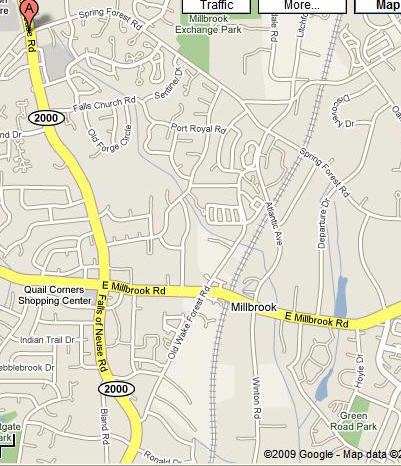
upper-marsh-creek-on-google-map

upper reaches of Marsh Creek on Google Maps

   Marsh Creek actually starts just above the blue line showing the creek on this map – at Sutton Square of Falls of the Neuse, its twin springs cradling one of the busiest – and for pedestrians, one of the most dangerous – stretches of four lane in Raleigh. This major creek, which runs for just over five miles from Spring Forest to its intersection with Crabtree, begins on the west side of Falls of the Neuse as a tiny landscaped pond (next to Northbend), and on the east side as the  rocky ditch seen below.

The little brook picks up size quickly as it travels downhill through Northeast Raleigh neighborhoods – alternating older large-lot subdivisions with newer townhouse projects.  It reaches a large natural area just above Old Wake Forest Road, and that’s where I had such fun.  A wide sewer cut gave access to a scrubby but rich haven tucked between neighborhoods, and I was able to see the deer tracks seen at the top of the post, a deer bedroom of crushed broomstraw, cute little coon prints on a sandbank, and a glimpse of a solemn woodchuck, who quickly scrambled into his hole.

Above, a mossy bank just north of Old Wake Forest Road.  Below is the sewer cut, which travels through several acres of undeveloped lowland.

After crossing Atlantic Avenue, where I found another hillside natural area covered with large, iron-rich boulders, the creek parallels that thoroughfare southward for a couple of miles – once again, touching on large older homes and much denser new developments. Before crossing New Hope Church Road it accepts the run-off from Mini-City to the east, and then enters Brentwood.  Here, the creek is the centerpiece of a long, narrow neighborhood park that runs down the center of the venerable and “transitioning” Brentwood subdivision.  It accepts the water from a neighborhood pond on Huntleigh (doubtless called a lake by the residents), and dives under Capital Boulevard, where we will pick it up the next time we visit Marsh Creek.
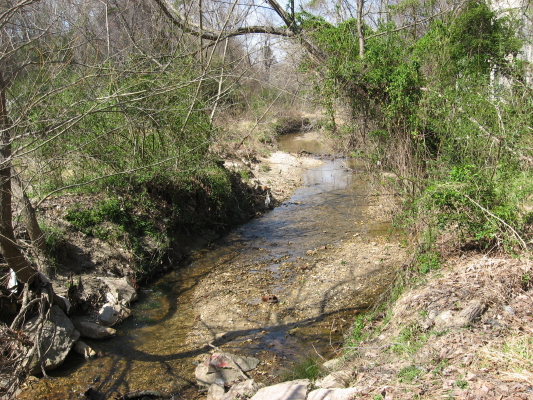
upper stretch of Marsh Creek

upper stretch of Marsh Creek

Photo album of upper Marsh Creek
 

March 19, 2009

Look down, look closely, at Spring’s lovely weeds

Filed under: Central Raleigh, Gems & Surprises, Nature Lore — Tags: — raleighnaturalist @ 2:17 am

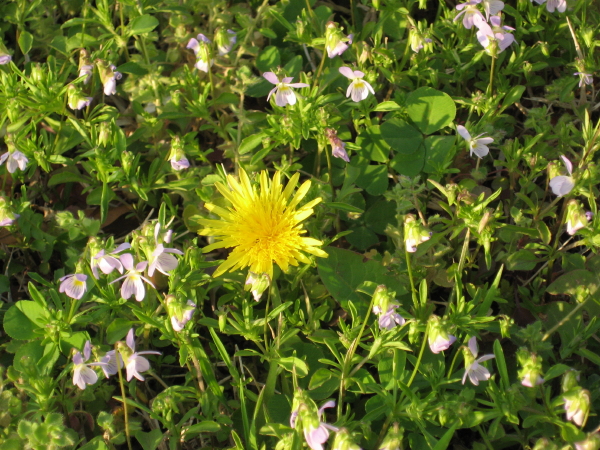
 wildflowers-and-dandelion

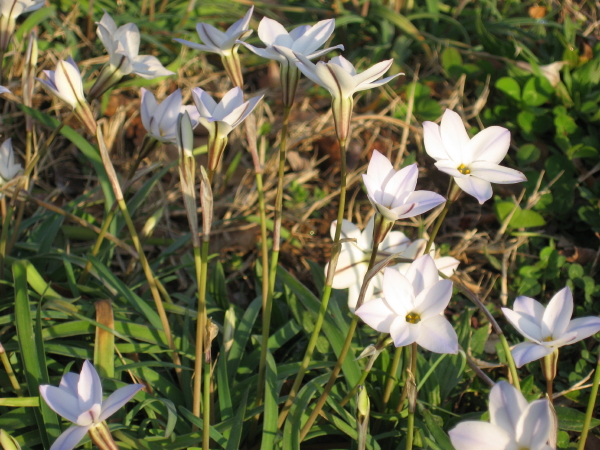
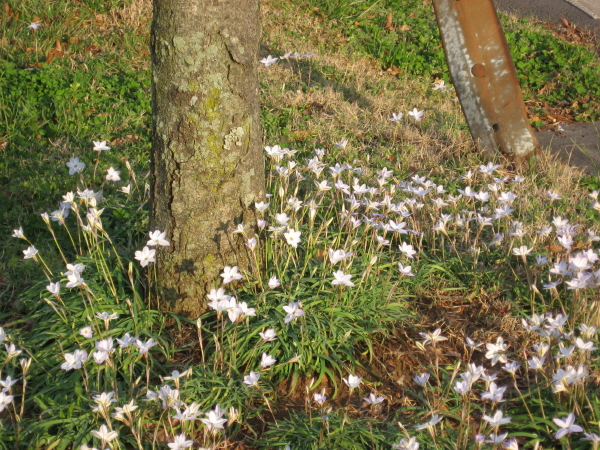
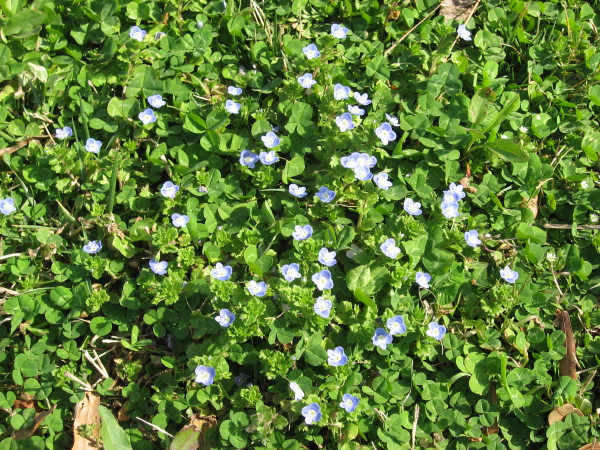
   Weeds are just plants someone thinks are out of place.  As the season arrives, we can all get some pleasure from these signs of a diverse ecosystem  in your yard.  Take the time to look down and closely!

snowflakes, an early bulbous wildflower

snowdrops, an early bulbous wildflower


snowflake-patch_1_1


blue-wildflowers_1_1

February 22, 2009

News, Notes, and Promises

Walnut Creek greenway at Wetland Center

Walnut Creek greenway at Wetland Center

 Walnut Creek Wetland Park is approximately 59 acres in size and is located between Garner Road and South State Street and south of Peterson Street in Southeast Raleigh. This site contains extensive wetlands that are located near the downtown urban center and offer an opportunity for the public to easily explore and learn about the value and significance of wetlands for water quality and wildlife habitat.     Raleigh City website

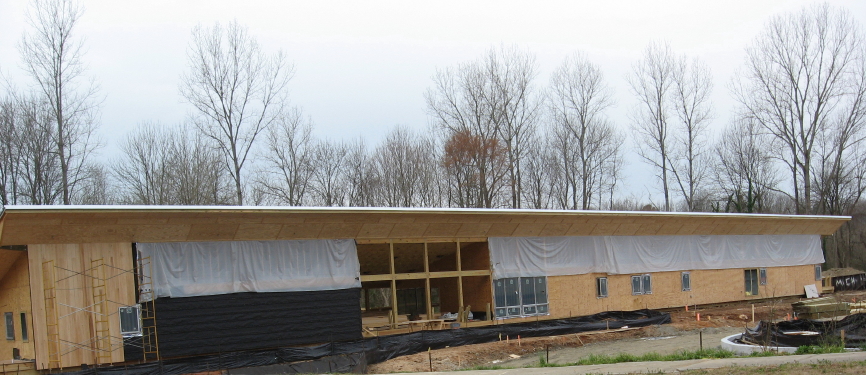
      Construction has begun on  the  Walnut Creek Wetland Center, as reported in NandO on February 11.   The center is the culmination of efforts led by Norman Camp to rehabilitate and protect the wetlands of Raleigh’s Southeast.   This topo map shows the area. The new building, shown below, was designed by Frank Harmon, and will stand six feet above the ground and have a minimal ecological footprint.  An earlier post describes some amenities of this section of greenway.

                         walnut-center-side_1_1                         walnut-wetlands-center-front_1_1

*************

henbit-on-hodge-rd_1_1

    The groundhog definitely saw his shadow, but early signs of spring abound in Raleigh.  Above is henbit between Hodge Road and Crabtree.  Below are red maples blossoms in Oakwood.  There is some cold air coming, so there will be some casualties – though our well-mulched garden parsley and “spinach under glass” on the deck are doing great!

winter-maple-buds_1_1

*************

     One of the exciting things about Raleigh Nature is the wonderful reader input, and I need to follow up and post about more of it.  There’s always a tension between getting around to it and doing it justice.  Here are a few smoldering issues on my draft posts:

First and most behind: responding to the multiple inputs about Lassiter Mill and Raleigh mill history.  From David’s great pics of the upper water, to the amazing Lassiter mill drive wheel images sent by Jimmy, and the history and memories in the comments, we need to return to this subject soon!  I recently got a fascinating inquiry from Carol about the infilled Lake Boone, and the natural springs that fed it, and I want badly to follow that up.  I very much appreciated the mistletoe tips from Meredith, and dream of my “pecans and mistletoe” map of Raleigh!  Scott, a well-known author, my old friend Joe, and Tommy, a songwriter from my past, all greatly helped my still-unfinished exploration of the Pigeon House Branch system and the expensive new Fletcher Water Park that feeds into it.  We’ve been blessed with an explanation of Raleigh Swamp’s waters by Mark, who engineered it, and we’ve been sobered by the plea for resolution from Deborah concerning Ward Transformer’s lifetime of ecological crimes against our area.    I look forward to sharing Patti’s wonderful hawk story, and keeping Michiel in the Netherlands all caught up on Raleigh’s natural scene.  Mentioning these highlights, many thanks to all who have written or commented.  It really helps the work!

**********

Oakwood maple

Oakwood maple

     Chris Crew and Matthew Brown just wrote a wonderful article about Oakwood wildlife for our neighborhood newsletter.They are neighbors at the bottom of the slope at whose crest I reside. Between my house and theirs almost every inch is controlled by humans, and the water flowing downhill is piped or culverted.  Below their house, toward Brookside and Glascock, the land opens up just a bit and has some natural edges. As a matter of fact, Chris is uncovering  the section of Grassy Branch in his backyard, and that’s another topic on my to-do list.  Just across the road, though, is Oakwood Cemetery, a significant oasis for many living things.  According to their article, our neighborhood boasts a huge variety of species. Among many bird species they describe, the cedar waxwing invasion for berries and the long-standing nest of red-tail hawks stood out.  Foxes, possums, and a substantial population of raccoons are described.  There are excellent nature lore tips regarding the colors of 5-lined skinks and owl sounds.  I wish the newsletter were online, but if you have a friend that’s a resident, check it out.  Way to go, Matthew and Chris!

PS:  Hope ya’ll like the revised sidebar.

PPS: Matthew very kindly posted the article referred to above HERE.

February 5, 2009

Midwinter Beech Luminaries

Filed under: Central Raleigh, Nature Lore — Tags: , , — raleighnaturalist @ 1:29 am

     At the easternmost tip of Raleigh’s greenways, Buckeye Trail at Milburnie Road, the young beeches, which keep their old leaves through the winter, look like luminaries spread through the flat lowland off this section of greenway. These pictures don’t really capture the effect – I’ll keep trying!

   This is close to the right time of day – right before dusk – and the dead of winter, but the eery quality involves the depth of their scattered penetration, evenly, through the slightly older but teenage pines…. and the perfectly flat lowland which nestles under Rollingwood where LongView Creek finds Crabtree.

     Midwinter is a great time to explore OFF the greenway, at least for poison ivy abhorrers like me.  The sewer cuts and fishing paths are available, and at this east end of Buckeye, the big beeches on the creek slopes have laid out startling off-white saplings to lighten up the dark winter texture of the woods.

December 14, 2008

Mistletoe Sightings

Filed under: Central Raleigh, East Raleigh, Nature Lore, Pecans & Mistletoe — Tags: , , — raleighnaturalist @ 8:19 pm
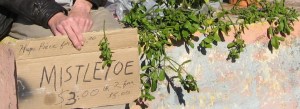
mistletoe-sign_1_1
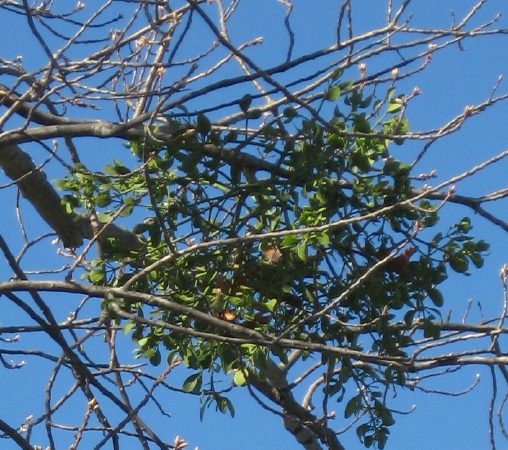
     Mistletoe is common in the Southern Piedmont and has a strong herbal tradition as a medicine and as a holiday superstition and game.  This evergreen parasite is spread by bird defecation after eating mistletoe berries.  The latter link from the NC Museum of Natural Sciences tells us the name derives from the Anglo phrase for  “dung-on-a-twig.” Three different species have a complex role in all this.  The species most commonly used as decoration, phoradendron flavescens, is a native of North America. In California, it is considered a parasitic pest.  Viscus album is the European species whose berries are poisonous and also useful as medicine.  The species in my pictures is Phoradendron leucarpum, oak mistletoe, considered less common and rare in Europe, but apparently it is Raleigh’s most common, and the one favored by European Druids for its alliance with the mighty oak.
wade-ave-close-up_1_1
  
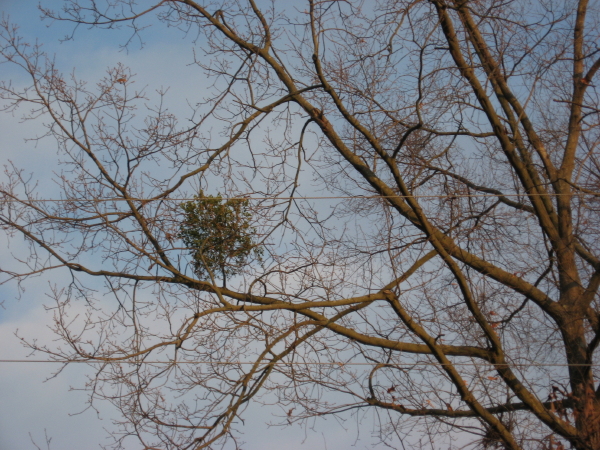
     Raleigh certainly has its share of oaks, and many of them in the area northwest of downtown sport the dusky green balls.  The spots inside the Beltline I best remember mistletoe are gone.  The planted median of Glenwood north of Peace Street used to have oaks that were full of prominent mistletoe, but I just today realized they have been replaced (quite some time ago – another geezer moment) with crepe myrtles, which are doubtless less trouble for the Progress Energy linemen.  But a large oak with a huge spread of mistletoe grows just across the street.  Mistletoe is not endangered: in fact I see it often in my travels, now that I have trained my eye to look for it.  But it does get harvested, and some  of what you see hanging in door jams is quite local indeed.
dans-mistletoe-stand_1_11
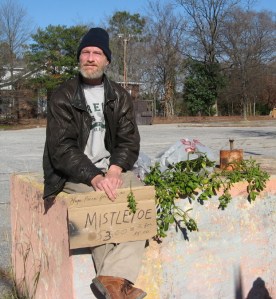
     Where do you get yours? Maybe from Dan, who was set up on Person Street as I drove out to take mistletoe pics for this post.  I explained our coincidence, bought a big branch and chatted about mistletoe.  I mentioned the old strategy I’d seen out at my country cousins of shooting it down with a shotgun.
     “Yeah, but that messes it all up.  I got this here the hard way – thirty feet up.”  From his yard, he said, but there is mistletoe in some public areas around town.  Does much inside the beltline get picked each year?  Wondering, I say goodbye to Dan and head out in search of unharvested mistletoe.  First stop is the most hilarious spot for mistletoe to hang: the corner of Cook and Oakwood.  The irony of this clump presiding over a corner where women of the street often hawk their sad-eyed wares in broad daylight is just too great for me to forbear mentioning.
Mistletoe at Oakwood Cemetery

Mistletoe at Oakwood Cemetery

     Heading out of downtown, I find nice groups at Harvey Street but none on Glenwood north of 5 Points.  Over on Wade, there are healthy stands at the SECU facility and on up that hill toward Oberlin.  The Canterbury/Banbury neighborhood has huge oaks, but many of them are Willow Oaks, and I saw almost no mistletoe there.  My schedule took me back toward home, and I saw the nice batches at the edge of Blount Street Commons.  This was a very partial and cursory inventory, but I plan to make this an annual post and develop a map of mistletoe sites in Raleigh (as I will for pecans, thus the name for my nature project blog).
****************
Suite101 Botanical info
***********
About.com’s mistletoe history
************
 
NC Farms Selling Organic & Low-Spray Christmas Trees and Wreaths (and Mistletoe)
************
Have a great holiday season!
 

November 22, 2008

Pigeon House Branch

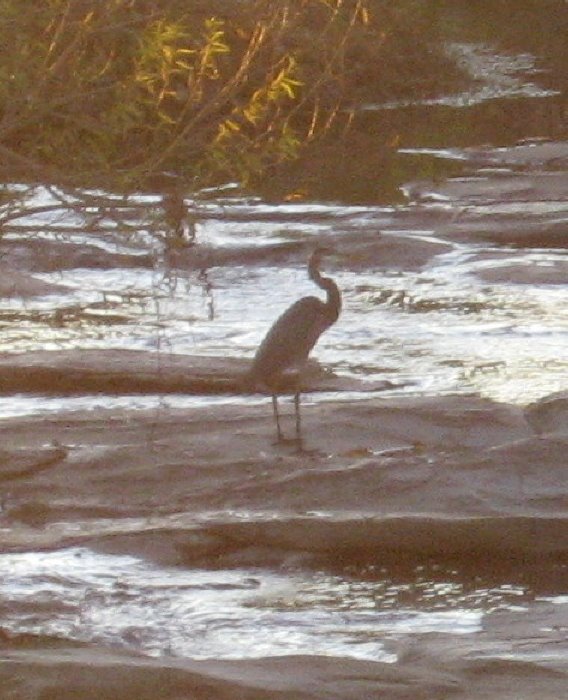
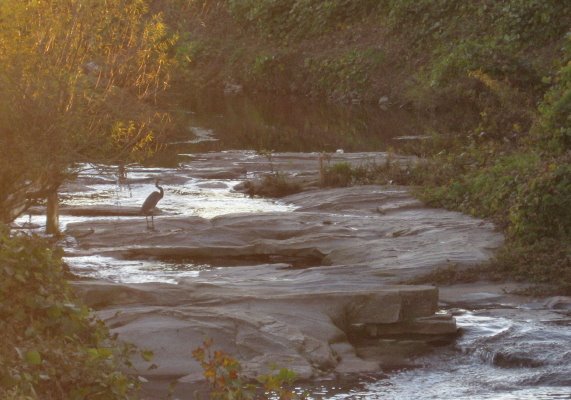
     A great blue heron browses Pigeon House Branch where it crosses over a granite outcrop.  The scene is tucked away in a very industrial part of central Raleigh – Capital Boulevard’s warehouse district, where the creek flows through huge kudzu-covered ditches on alternating sides of the thoroughfare.  Pigeon House is the most prominent waterway in central Raleigh, but also its most abused. (last text link is info, all others are pictures).

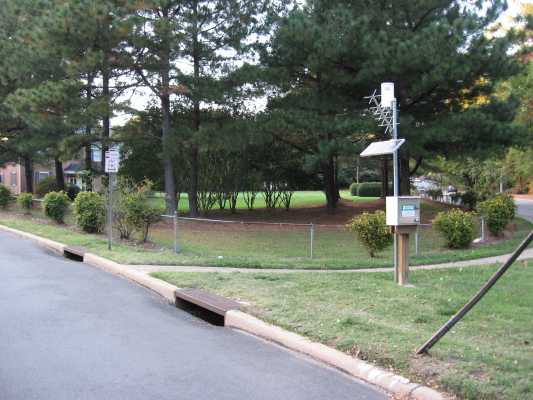
sw-tributary_1_1The streamwatch station denotes a creek under these storm sewers at the SE edge of Cameron Village.

Transportation Plan map of Pigeon House creek

  It gathers its headwaters in Edna Metz Park  just off Cameron Village, and this upper part of the creek was shifted and ditched in order to build Cameron Village.  From Edna Metz, concrete culverts carry it through Cameron Park and east down Johnson Street, where it crosses under Peace Street to be culverted again through the former Devereux Meadows, which is now a city facility for trash trucks and a salt barn.

    Flowing north beside Capital Boulevard, the creek drains two railroad lines as well as a massive entertwining of concrete roadways.  A highlight of this stretch is the Light+Time art tower, which presides over the union of Pigeon House with the waters from Fred Fletcher Park. As it borders the service road for the warehouse strip, it finds the rock outcrop frequented by the heron. It dives under Capital to emerge almost underneath the venerable Watkins Grill on Louisburg Road, then criss-crosses Capital back and forth again before heading east toward Crabtree Creek. We will pick it up at The Foxy Lady and follow it down to Raleigh Swamp another post soon.

The heron has found a beautiful spot in unlikely territory.  As the city makes efforts to rehabilitate its tributaries, Pigeon House Creek continues to flow as naturally as it can through northwest downtown.  We should notice it and help it out anyway we can.

Pigeon House Creek photo sequence

(from Cameron Village to Dennis Ave and Capital)

All RN post on Pigeon House Branch

« Newer PostsOlder Posts »

Create a free website or blog at WordPress.com.