The Raleigh Naturalist

April 10, 2009

Marsh Creek Meanders

Filed under: Nature Lore, Northeast Raleigh, waterways — Tags: , , — raleighnaturalist @ 3:33 pm

   I had the most nature fun OFF the greenway in a long time, searching the headwaters of Marsh Creek.  This prototypical Piedmont creek – running due Southeast and carrying red clay hills down to sandy flats – ends up dumping its large steady flow of water into a huge wetland at the Yonkers Road section of the Beltline – thus its name.  This lower section is full of treats, and will constitute part two of this post.  Recently I browsed through North Raleigh sewer cuts and subdivisions, climbing up Marsh Creek as I did.  My destination – the headwaters – came as a surprise, and emphasized the fascinating cross section of Northeast Raleigh this creek travels through on its way to Crabtree.
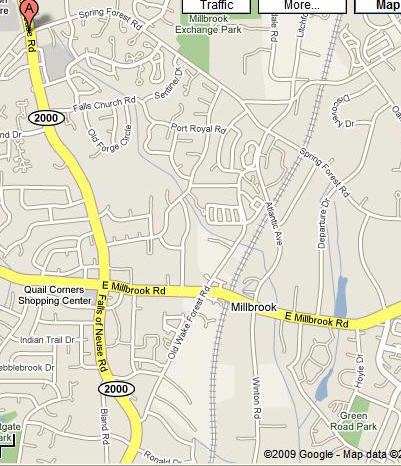
upper-marsh-creek-on-google-map

upper reaches of Marsh Creek on Google Maps

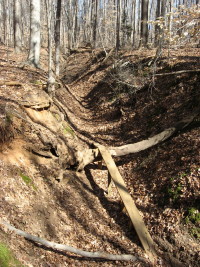
   Marsh Creek actually starts just above the blue line showing the creek on this map – at Sutton Square of Falls of the Neuse, its twin springs cradling one of the busiest – and for pedestrians, one of the most dangerous – stretches of four lane in Raleigh. This major creek, which runs for just over five miles from Spring Forest to its intersection with Crabtree, begins on the west side of Falls of the Neuse as a tiny landscaped pond (next to Northbend), and on the east side as the  rocky ditch seen below.

The little brook picks up size quickly as it travels downhill through Northeast Raleigh neighborhoods – alternating older large-lot subdivisions with newer townhouse projects.  It reaches a large natural area just above Old Wake Forest Road, and that’s where I had such fun.  A wide sewer cut gave access to a scrubby but rich haven tucked between neighborhoods, and I was able to see the deer tracks seen at the top of the post, a deer bedroom of crushed broomstraw, cute little coon prints on a sandbank, and a glimpse of a solemn woodchuck, who quickly scrambled into his hole.

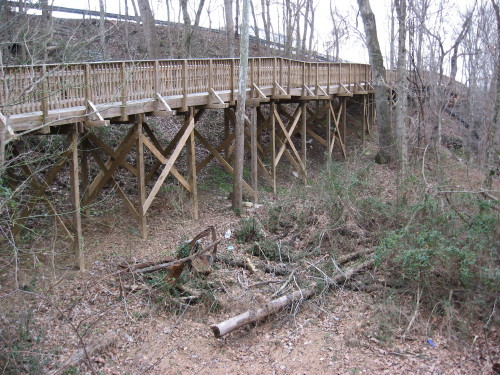
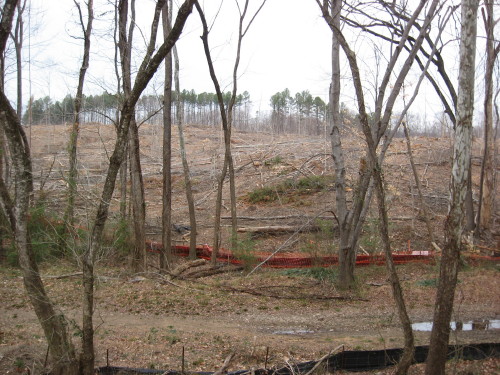
Above, a mossy bank just north of Old Wake Forest Road.  Below is the sewer cut, which travels through several acres of undeveloped lowland.

After crossing Atlantic Avenue, where I found another hillside natural area covered with large, iron-rich boulders, the creek parallels that thoroughfare southward for a couple of miles – once again, touching on large older homes and much denser new developments. Before crossing New Hope Church Road it accepts the run-off from Mini-City to the east, and then enters Brentwood.  Here, the creek is the centerpiece of a long, narrow neighborhood park that runs down the center of the venerable and “transitioning” Brentwood subdivision.  It accepts the water from a neighborhood pond on Huntleigh (doubtless called a lake by the residents), and dives under Capital Boulevard, where we will pick it up the next time we visit Marsh Creek.
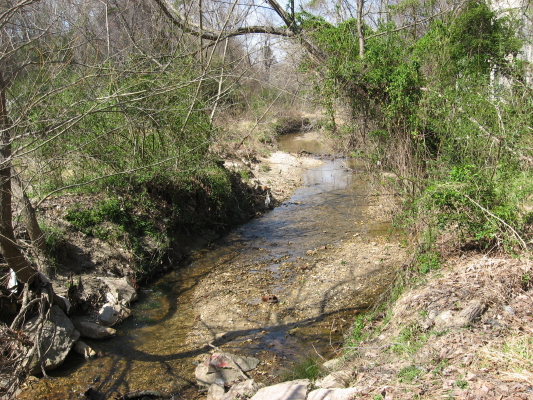
upper stretch of Marsh Creek

upper stretch of Marsh Creek

Photo album of upper Marsh Creek
 

February 6, 2009

Pigeon House Branch Part 2

heron-on-rock-outcrop_1_1

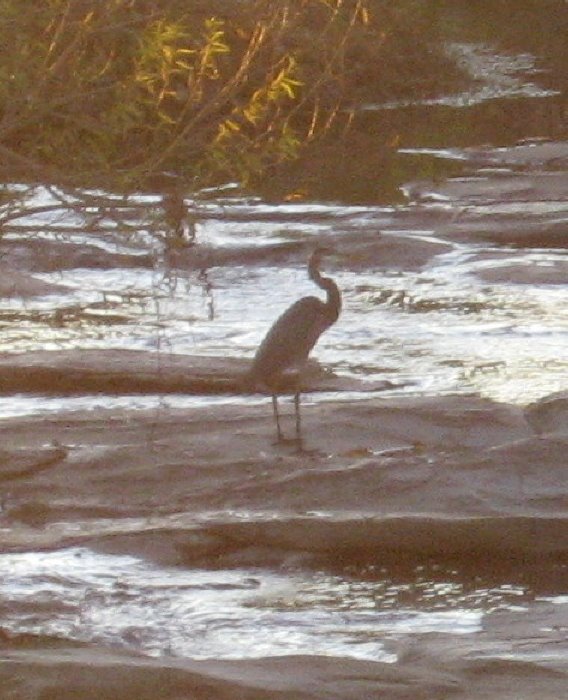
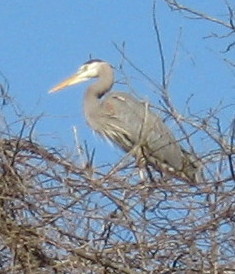
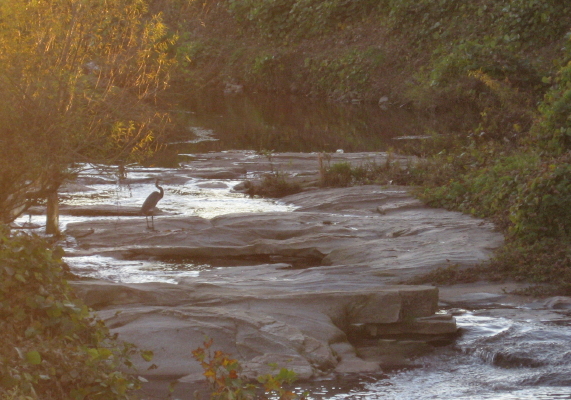
     In our previous post, we began with the hidden headwaters of Pigeon House under Cameron Village, and followed it through the the Park Avenue  neighborhood and down West Johnson Street to Peace Street, with a reach-out to Capital at Wake Forest, where the heron above (remember all pictures should click to enlarge) found a rocky spot of wilderness.  This post backs up to Devereux Meadows and follows Pigeon House Branch down to its intersection with Crabtree Creek. An unhappy course, for the most part. The city is trying to rehabilitate it, one tributary at a time. Below is the map of their plan.

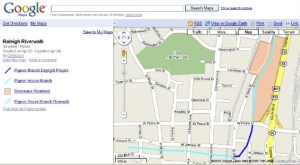
pigeon-house-plan-map_1_1

     Pigeon House Branch drains the northwestern quadrant of downtown, gathering water east of the Oberlin Road ridge, bringing it through a series of open stone culverts through the Park Drive neighborhood.  At St. Mary’s Street it enters the Glenwood South business district and is piped under the roads and railroads tracks and down to Devereux Meadows.   The dark blue line is where they want to uncover the creek, and the brown area is where the city wants to create a “Riverwalk”  at Devereux Meadows.  Below we see the creek as it begins its path through this area.

     Pigeon House Branch is under there somewhere!  The creek escapes out a large pipe and continues down between West Street and Capital Boulevard.  About here is where the 42 inch pipe pictured below delivers all the water collected from Fletcher Park and its $700,000 water park!

     Pigeon House crosses back and forth across Capital Boulevard, traveling through wide manmade ditches covered with kudzu.  The water passes over the heron’s rock outcrop and turns northeast.  It dives under Capital yet again and emerges at Watkin’s Grill, a venerable blue-collar breakfast joint at Old Louisburg Road and Atlantic Ave.  Traveling between the north and southbound lanes of Capital, it accepts the water from off the Blount St. ridge (Mordecai to Oakwood), and makes its way through successive parking lots, including Johnny’s Motel, Dunkin’ Donuts, The Foxy Lady and the bowling alley for over a mile, before turning east at Crabtree Boulevard.  Here Pigeon House lends its seepage to a small marsh between it and Crabtree Creek.  It feeds into Crabtree at Raleigh Boulevard, its mouth visible from its bridge over Crabtree as well as the nearby greenway deck.

Pigeon House Branch enters Crabtree Creek

     Pigeon House is decidedly urban and yet makes its way through former waste lowlands turned into thoroughfares, so its riparian buffer is actually less stressed for space than many other creeks in Raleigh.  Thus the heron, thus the opportunity for a high-end greenway at the site where I watched many a minor league baseball game.  Much hope can be found for success with the city’s project to rehabilitate Pigeon House Branch.

pdf. Pigeon House Plan

Pigeon House Part 2 photo album

This is a thorough sequence from Devereux Meadows to Crabtree Creek.

November 22, 2008

Pigeon House Branch

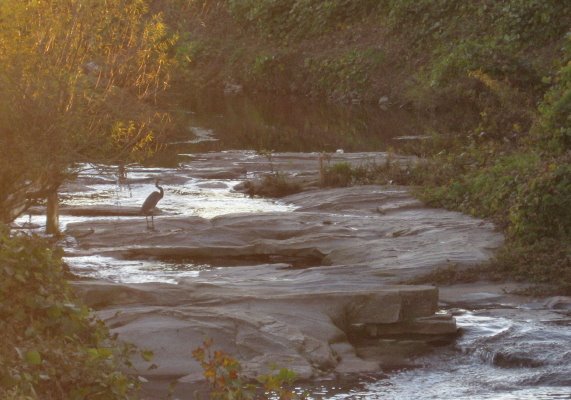
     A great blue heron browses Pigeon House Branch where it crosses over a granite outcrop.  The scene is tucked away in a very industrial part of central Raleigh – Capital Boulevard’s warehouse district, where the creek flows through huge kudzu-covered ditches on alternating sides of the thoroughfare.  Pigeon House is the most prominent waterway in central Raleigh, but also its most abused. (last text link is info, all others are pictures).

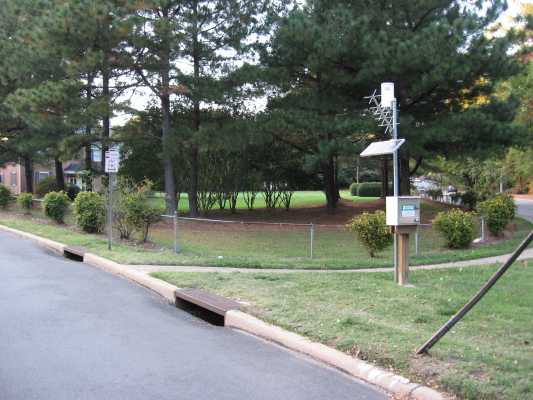
sw-tributary_1_1The streamwatch station denotes a creek under these storm sewers at the SE edge of Cameron Village.

Transportation Plan map of Pigeon House creek

  It gathers its headwaters in Edna Metz Park  just off Cameron Village, and this upper part of the creek was shifted and ditched in order to build Cameron Village.  From Edna Metz, concrete culverts carry it through Cameron Park and east down Johnson Street, where it crosses under Peace Street to be culverted again through the former Devereux Meadows, which is now a city facility for trash trucks and a salt barn.

    Flowing north beside Capital Boulevard, the creek drains two railroad lines as well as a massive entertwining of concrete roadways.  A highlight of this stretch is the Light+Time art tower, which presides over the union of Pigeon House with the waters from Fred Fletcher Park. As it borders the service road for the warehouse strip, it finds the rock outcrop frequented by the heron. It dives under Capital to emerge almost underneath the venerable Watkins Grill on Louisburg Road, then criss-crosses Capital back and forth again before heading east toward Crabtree Creek. We will pick it up at The Foxy Lady and follow it down to Raleigh Swamp another post soon.

The heron has found a beautiful spot in unlikely territory.  As the city makes efforts to rehabilitate its tributaries, Pigeon House Creek continues to flow as naturally as it can through northwest downtown.  We should notice it and help it out anyway we can.

Pigeon House Creek photo sequence

(from Cameron Village to Dennis Ave and Capital)

All RN post on Pigeon House Branch

June 29, 2008

Bikes Trails RIP – highlights greenway loss

Filed under: Central Raleigh, Crabtree Creek, Greenways & Parks, North Raleigh, waterways — Tags: , , — raleighnaturalist @ 9:08 pm

This post was originally posted on March 6, 2008.


The destruction of the bike trails described by Joe Miller is not just significant for these bandit bikers: all users of the greenway between Atlantic Avenue and Capital Boulevard should mourn the loss of this old farm site, whose naked hillsides (and future clapboard townhouses) are easily visible from the greenway. Riparian buffer is the term for the ecological value of these wooded areas contiguous with the greenway:  the trees absorb rain as well as pollution, shade and cool the waters of Crabtree.  Of course, the wildlife appreciates wooded areas next to the creek as well.

***********

This is a rich and variegated section of greenway with lots of interesting features in addition to the old farm site.  If you park off Capital Blvd. at its intersection with Yonkers Road, you will have to jump the barrier that tells you this problematic section of greenway deck needs shoring up.  The risk seems minimal, and I’ve done it many times.  From this deck you can see the naked hillsides, and then follow that section of greenway as it heads toward Atlantic Avenue.

************

view-from-atlantic-ave_1_1

A view from the greenway of what Joe Miller describes as the mohawk look.

 Above is the view from the new development at the south end of Six Forks.

This lovely path begins at the base of the hillside deck and heads straight toward the southbound ramp off the beltline for Capital Boulevard.  If this stretch survives the development, that will be significant for this greenway section.


From the west end of the problematic deck, you are looking toward Atlantic Avenue.  This stretch parallels Hodges Road and looks across Crabtree at the old site for the State Farmer’s Market.  Below you see a bog visible to the right of this stretch.


Now just across this bog we have an interesting situation. Several fellows have set up a tent just behind the Atlantic Ave marsh area and are creating quite a trash pile nearby.  The trash is visible from the greenway, but won’t be long as things green in. I have observed these camps and also the urban “nesting sites” downtown and under bridges for many years and almost never gotten bad vibes from them.  But that is some nasty trash!  We’ll end the post with the sunset cattails which are literally within sight of the tent and trash.  Be careful out there!


 The marsh below has been short of water since well before the drought.  It appears to me that the greenway construction changed the drainage somehow.  What you’re looking at used to stay under two feet of water most of the year.  I guess the incoming water and sedimentation will re-adjust things over time.  Anybody know?

December 16, 2007

Raleigh Geography

Filed under: Crabtree Creek, Geographic Areas, Raleigh History, waterways — Tags: , , , , — raleighnaturalist @ 2:19 am

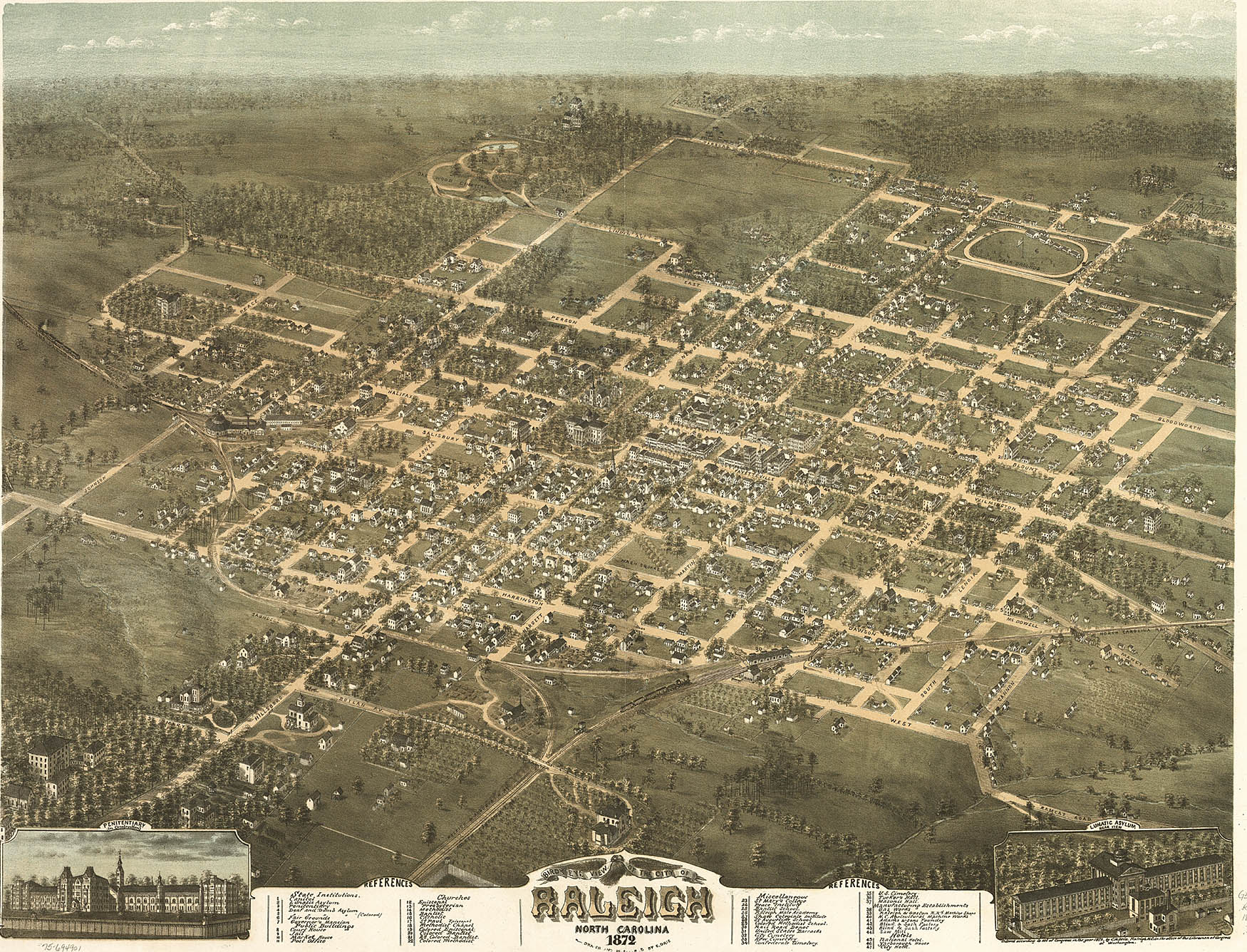
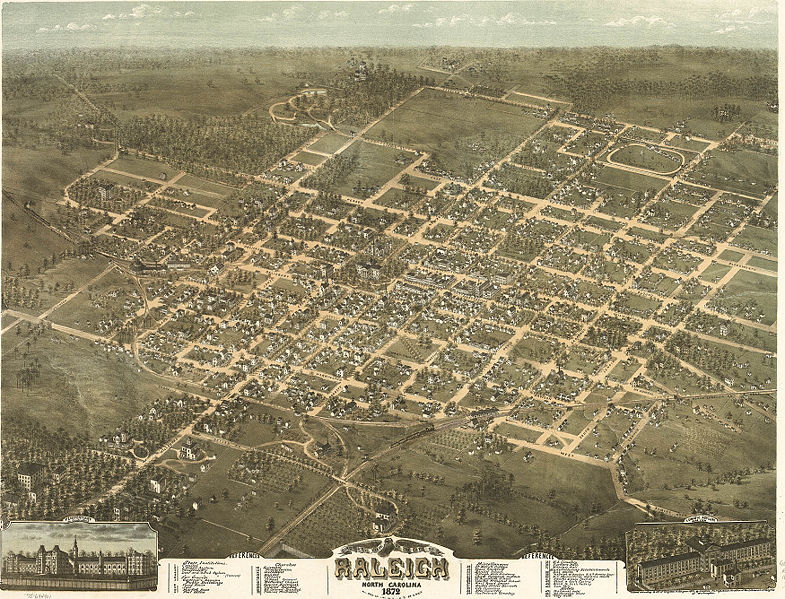
Raleigh in 1872

Google Map of Raleigh

Topo Map of My Childhood

Google Image of Buckeye Trail

   Raleigh is, of course, an invented city.   Planned in advance at a tavern somewhere between Litchford and Falls of the Neuse, drawn in regular squares, purchased from Joel Lane for about $3 an acre, 400 acres of the one thousand purchased were divided and sold in lots to the prominent families who expected to inhabit it, with five large squares reserved for community purposes.  It is reminiscient of D.C. in its ordered squares and patterns of street names, but nevertheless a fairly typical large Southern town in many respects, with a seasoning of “cow-path roads” to leaven those squares.  The early city expanded its boundaries in 1857, avoided destruction in 1865, and then then expanded again in 1907 with some of the South’s first “suburbs,” – serviced by trolley lines!  Hayes Barton, named for the deer-filled English homeland of Sir Walter, was a prime example.  Raleigh’s growth went straight north for many decades after that, but has recently expanded in lots of directions -though not evenly.  Rural scenes can still be had with just a few minutes driving going south or especially east.

********** 

   Crabtree Creek dominates Raleigh geography, just as it does this blog.  It drains a huge swath of land across Wake County.  Its head waters are in west Cary and it empties into the Neuse at Anderson Point just off US 64 East.  In between, it makes a slow northward curve that defined the Beltline right of way with useless lowlands, then slopes southward to its union with the Neuse.  If Crabtree stayed full, it would be a river itself, and it often outdoes the Neuse in flow after heavy rains.  But ours is a low flow water system with periodic normal droughts.  Crabtree often barely moves through the huge ditches it has carved into the sediments of lowland Raleigh.  When it roars, it scours these floodplains with a muddy concoction of tree trunks, lumber and flotsam that can dress the landscape in astonishing sights.  Thus the cheap right-of-way.  But no more!  Stores on huge slabs of fill dirt, townhouses on stilts, rich slopeside houses with mandatory first floor basements – Raleigh has embraced the floodplains.  And Crabtree has been ditched and channeled, dammed and diverted to save the shopping center.  Walnut Creek’s much smaller but intricate watershed drains the southern half of the city.  And Swift Creek below that flows through and forms some of the most fascinating wildlife areas in the Triangle.

************ 

   Water is what maps an area.  We get ours from Falls Lake, due north, and return the treated waste water to the Neuse southeast of here. Crabtree and Walnut Creek wrap around the high ground of downtown and North Hills like bow legs, reaching the river just a couple of miles apart.  Our waterways have gained the dual importance of riparian buffer and wildlife habitat, and the parks and greenways map right on to the waterways with few exceptions. A map of wildlife inside the beltline might as well be a map of the creeks.  So that is where this blog will tend to find itself – streamside.

heron-facing

« Newer Posts

Create a free website or blog at WordPress.com.