The Raleigh Naturalist

December 14, 2008

Mistletoe Sightings

Filed under: Central Raleigh, East Raleigh, Nature Lore, Pecans & Mistletoe — Tags: , , — raleighnaturalist @ 8:19 pm
mistletoe-sign_1_1
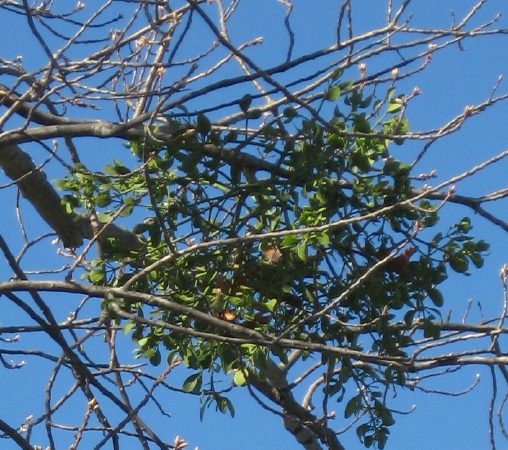
     Mistletoe is common in the Southern Piedmont and has a strong herbal tradition as a medicine and as a holiday superstition and game.  This evergreen parasite is spread by bird defecation after eating mistletoe berries.  The latter link from the NC Museum of Natural Sciences tells us the name derives from the Anglo phrase for  “dung-on-a-twig.” Three different species have a complex role in all this.  The species most commonly used as decoration, phoradendron flavescens, is a native of North America. In California, it is considered a parasitic pest.  Viscus album is the European species whose berries are poisonous and also useful as medicine.  The species in my pictures is Phoradendron leucarpum, oak mistletoe, considered less common and rare in Europe, but apparently it is Raleigh’s most common, and the one favored by European Druids for its alliance with the mighty oak.
wade-ave-close-up_1_1
  
     Raleigh certainly has its share of oaks, and many of them in the area northwest of downtown sport the dusky green balls.  The spots inside the Beltline I best remember mistletoe are gone.  The planted median of Glenwood north of Peace Street used to have oaks that were full of prominent mistletoe, but I just today realized they have been replaced (quite some time ago – another geezer moment) with crepe myrtles, which are doubtless less trouble for the Progress Energy linemen.  But a large oak with a huge spread of mistletoe grows just across the street.  Mistletoe is not endangered: in fact I see it often in my travels, now that I have trained my eye to look for it.  But it does get harvested, and some  of what you see hanging in door jams is quite local indeed.
dans-mistletoe-stand_1_11
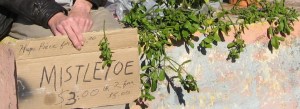
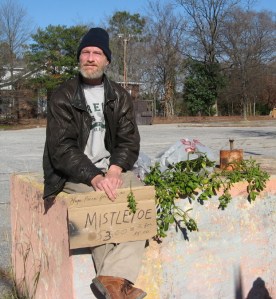
     Where do you get yours? Maybe from Dan, who was set up on Person Street as I drove out to take mistletoe pics for this post.  I explained our coincidence, bought a big branch and chatted about mistletoe.  I mentioned the old strategy I’d seen out at my country cousins of shooting it down with a shotgun.
     “Yeah, but that messes it all up.  I got this here the hard way – thirty feet up.”  From his yard, he said, but there is mistletoe in some public areas around town.  Does much inside the beltline get picked each year?  Wondering, I say goodbye to Dan and head out in search of unharvested mistletoe.  First stop is the most hilarious spot for mistletoe to hang: the corner of Cook and Oakwood.  The irony of this clump presiding over a corner where women of the street often hawk their sad-eyed wares in broad daylight is just too great for me to forbear mentioning.
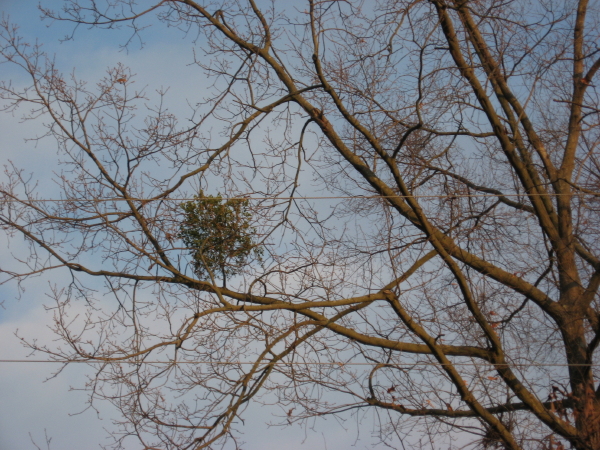
Mistletoe at Oakwood Cemetery

Mistletoe at Oakwood Cemetery

     Heading out of downtown, I find nice groups at Harvey Street but none on Glenwood north of 5 Points.  Over on Wade, there are healthy stands at the SECU facility and on up that hill toward Oberlin.  The Canterbury/Banbury neighborhood has huge oaks, but many of them are Willow Oaks, and I saw almost no mistletoe there.  My schedule took me back toward home, and I saw the nice batches at the edge of Blount Street Commons.  This was a very partial and cursory inventory, but I plan to make this an annual post and develop a map of mistletoe sites in Raleigh (as I will for pecans, thus the name for my nature project blog).
****************
Suite101 Botanical info
***********
About.com’s mistletoe history
************
 
NC Farms Selling Organic & Low-Spray Christmas Trees and Wreaths (and Mistletoe)
************
Have a great holiday season!
 

November 22, 2008

Pigeon House Branch

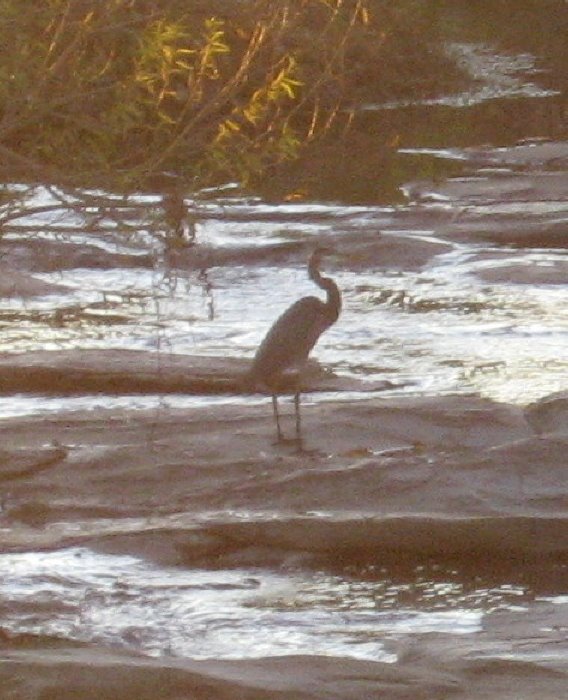
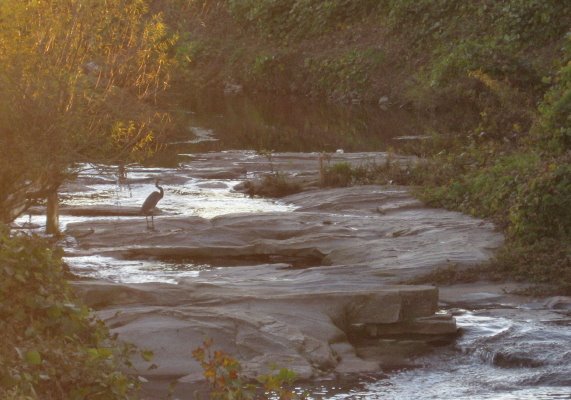
     A great blue heron browses Pigeon House Branch where it crosses over a granite outcrop.  The scene is tucked away in a very industrial part of central Raleigh – Capital Boulevard’s warehouse district, where the creek flows through huge kudzu-covered ditches on alternating sides of the thoroughfare.  Pigeon House is the most prominent waterway in central Raleigh, but also its most abused. (last text link is info, all others are pictures).

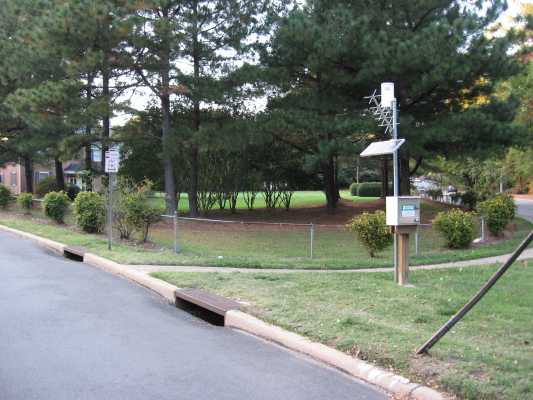
sw-tributary_1_1The streamwatch station denotes a creek under these storm sewers at the SE edge of Cameron Village.

Transportation Plan map of Pigeon House creek

  It gathers its headwaters in Edna Metz Park  just off Cameron Village, and this upper part of the creek was shifted and ditched in order to build Cameron Village.  From Edna Metz, concrete culverts carry it through Cameron Park and east down Johnson Street, where it crosses under Peace Street to be culverted again through the former Devereux Meadows, which is now a city facility for trash trucks and a salt barn.

    Flowing north beside Capital Boulevard, the creek drains two railroad lines as well as a massive entertwining of concrete roadways.  A highlight of this stretch is the Light+Time art tower, which presides over the union of Pigeon House with the waters from Fred Fletcher Park. As it borders the service road for the warehouse strip, it finds the rock outcrop frequented by the heron. It dives under Capital to emerge almost underneath the venerable Watkins Grill on Louisburg Road, then criss-crosses Capital back and forth again before heading east toward Crabtree Creek. We will pick it up at The Foxy Lady and follow it down to Raleigh Swamp another post soon.

The heron has found a beautiful spot in unlikely territory.  As the city makes efforts to rehabilitate its tributaries, Pigeon House Creek continues to flow as naturally as it can through northwest downtown.  We should notice it and help it out anyway we can.

Pigeon House Creek photo sequence

(from Cameron Village to Dennis Ave and Capital)

All RN post on Pigeon House Branch

November 1, 2008

Slow Fall at Dix


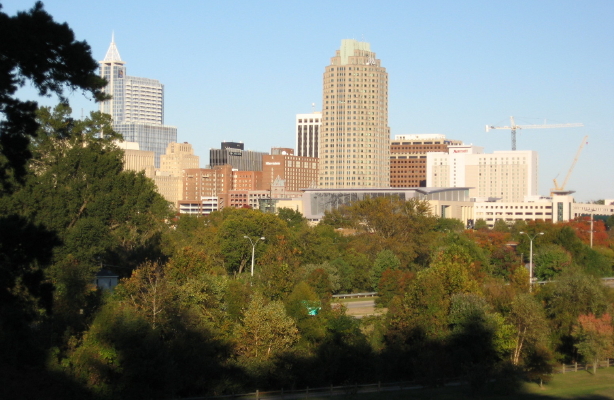
Raleigh from Dix Hill

Raleigh from Dix Hill

 Dorothea Lynde Dix (1802-87) was perhaps the most famous and admired woman in America for much of the nineteenth century. Beginning in the early 1840s, she launched a personal crusade to persuade the various states to provide humane care and effective treatment for the mentally ill by funding specialized hospitals for that purpose.

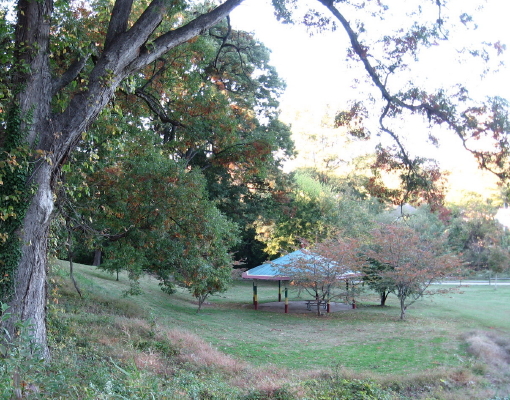
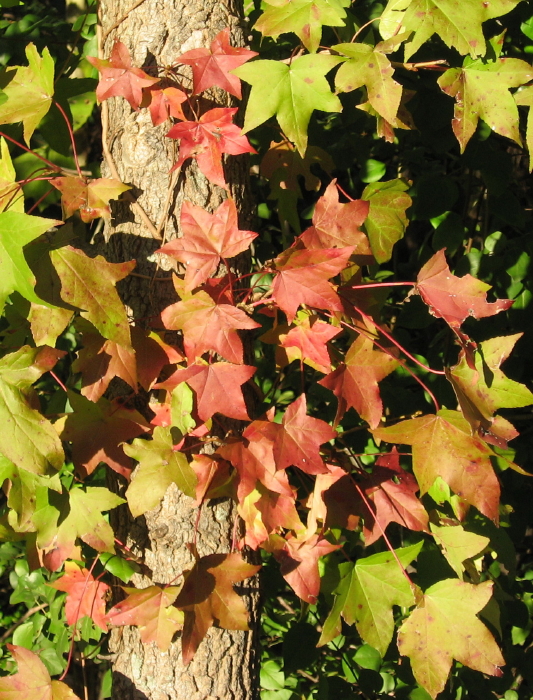
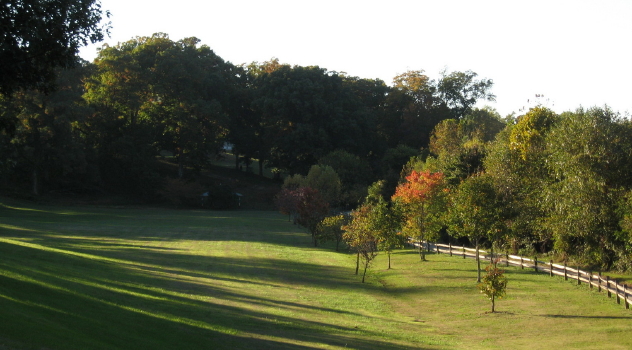
     306 acres are left from a huge estate that was given over to the benefit of some of our neediest folks.  As the fall colors take their time this year decorating Raleigh’s skyline, so Dix Hill’s fate lingers in the slow balance of state decision.  Walk the big meadow with me and glimpse some early fall colors.

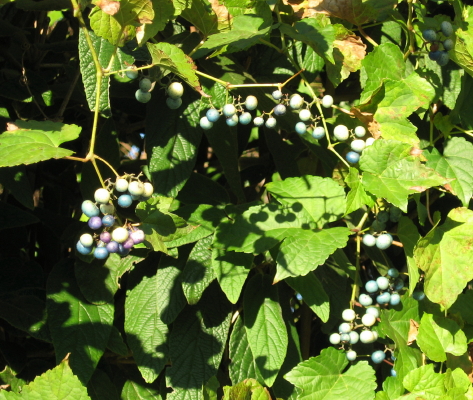
   We turn from downtown and look down at the gazebo and greenway path which runs along Rocky Branch as it follows its new, straightened course beside Western Boulevard.  On that walk we’ll see lots of elusive birds, wild grape, and some small spots of fall color.

     The campus has many historic buildings, massive white and red oaks that ring the meadow, a small grove of highly productive pecan trees, and one open slope that is the joys of all sledders.  Centennial Campus and the Farmer’s Market have already taken the lion’s share of what once was .  Now the state needs to let Raleigh’s long term interests take precedence over a short-time cash windfall.  The folks at Dix 306 are working hard to make that happen.  We should support them any way we can.

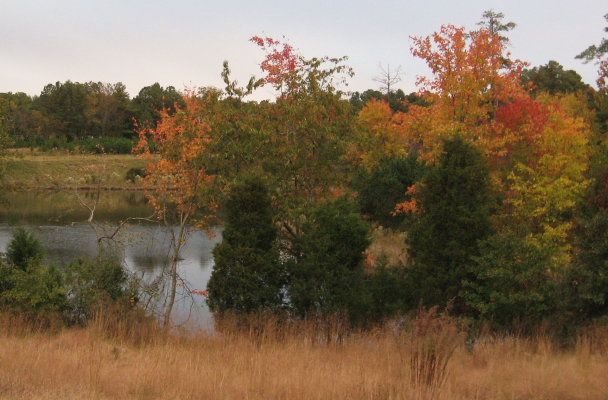
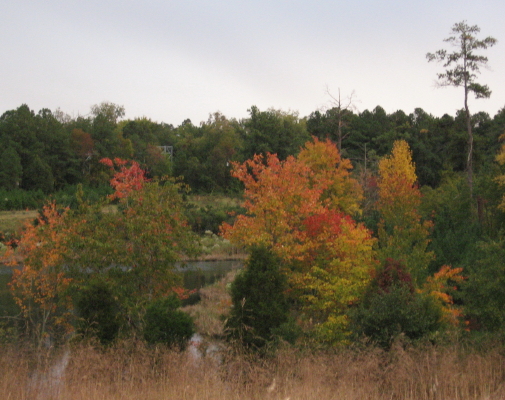
     Below is a trace of fall glory in midst of a glorious lingering summer.  Hopefully this image does not represent the sunset of hopes for the landscapes of Dix Hill.

****************

   I went on this walk partly because of Ashley Sue over at Green Grounded, who complimented me in anticipation of seeing fall colors on Raleigh Nature.  Below are clickable thumbnails of some other sightings at Jones lake off Sunnybrook, and then ending with my all time best fall picture, from the west Beltline.  Happy leafing!


October 20, 2008

Blue Ridge Parkway and other waypaths

   The Blue Ridge Parkway serves as a ribbon of access to the peaceful grace of both rural and wild scenes in the NC mountains.  The stretch surrounding Doughton Park, where Cara and I camped in August, offers more of the agricultural type.  The Parkway passes through currently used farms, with cows, sheep, goats and small gardens.  Near Doughton Park is Brinegar Cabin, whose old style of mountain farm living was enacted, and thus preserved, well into the 20th century. I posted a set of documentary photos about it at Pecans & Mistletoe, which is fast becoming the home of my explorations into heritage sustainable agriculture as well as a site for extended nature projects of all kinds. The nature images from our trip are on a post at the Raleigh Nature Photo Archive, which, like Pecans & Mistletoe, is a blogspot blog where I load and display most of the pictures for The Natural History of Raleigh, which is the name of my overall nature project and the future book which will culminate the work of these three blogs: Raleigh Nature, the main site, Raleigh Nature Photos, the photo album site, and Pecans & Mistletoe, the nature project site.  Occasionally some piece of all this leaks over into Raleigh Rambles, my personal blog, where I can talk about anything I want.
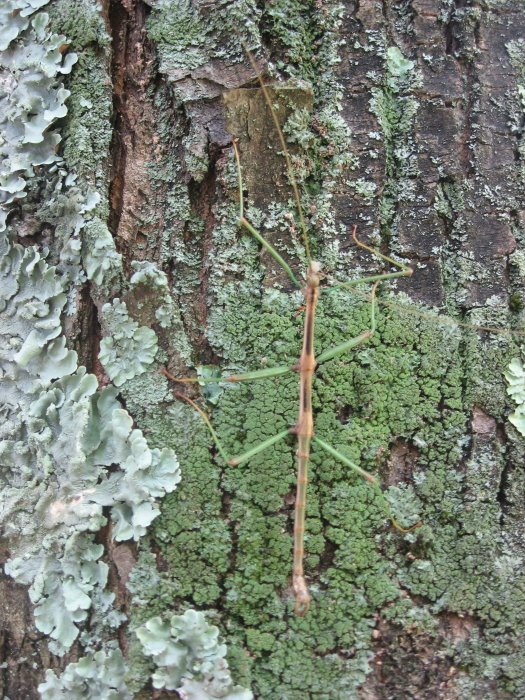
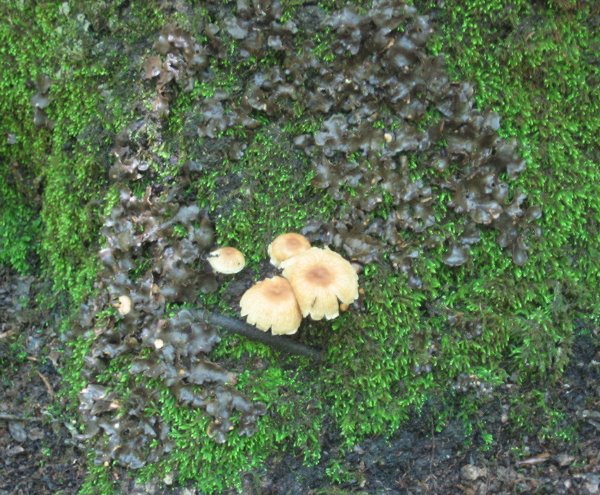
   Getting back to our mountain trip, we saw a beautiful pair of walking sticks at our campsite on the grassy knob of Doughton Park.  There are campsites at this park where you can walk out your tent, start down the hillside behind you, and go for a day or so before hitting a road.  We took a long hike through a nearby wooded trail and saw lots and lots of mushrooms, as you will see on the photo album.  Below is a particularly lovely grouping of shrooms, moss, and liverworts.

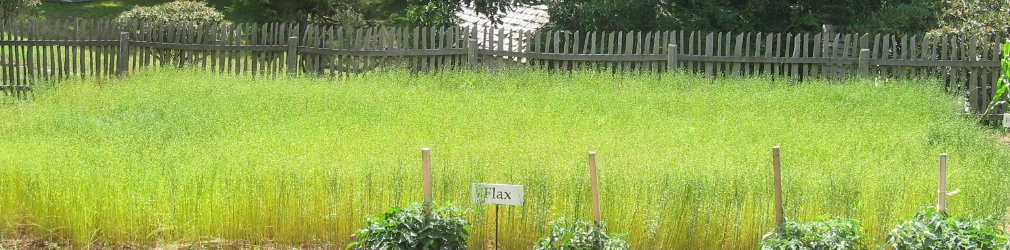
    Brinegar Cabin, which is right on the Parkway, really reminds you of how closely we lived with nature until not so many decades ago.  The Spring House (which is now contaminated by a Park Service outhouse built uphill from it), the naturally cooled food cellar, and the “linsey-wooly” products and cobbling service which generated cash money, all are vivid reminders of a way of life that, at this site, lasted until the 1930’s.  Best of all was the sights and lessons of growing and processing flax, which excites papermakers like ourselves very much.

September 25, 2008

Fallon Park – a long, fine necklace in Raleigh’s greenway jewels

 Fallon Park, just northeast of Five Points, and sloping with its long narrow shape down to Crabtree Creek at Anderson Drive, is a long necklace in Raleigh’s park jewels. The remains of a small mill structure lend even more interest to a wonderful rockfall along the creek that defines the park.  Fallon Creek is short : its headwaters gather right in the front yards of the very well appointed houses along White Oak Road off Anderson Drive.  The long skinny park has an unpaved path that is heavily used by joggers, walkers and doggers.  I never go on the weekend, but I have such fond memories of going there on weekday afternoons with my small children, chasing crawfish in the rockpools and climbing around the old mill structure.  It is a clean, rock-filled creek with a wide range of trees and plants arranged around its slopes.  There are small grass meadows at the top and bottom.  It serves a surrounding community that maintains rich, semi-organic plantings in its large yards, and it drains steep wooded slopes with older houses and little construction.  The creek’s quality reflects all of that.

Rockpools where Lily and Dori and I fished many times.

Rockfall and brick mill structure.

Fallon Park photo tour

*****************

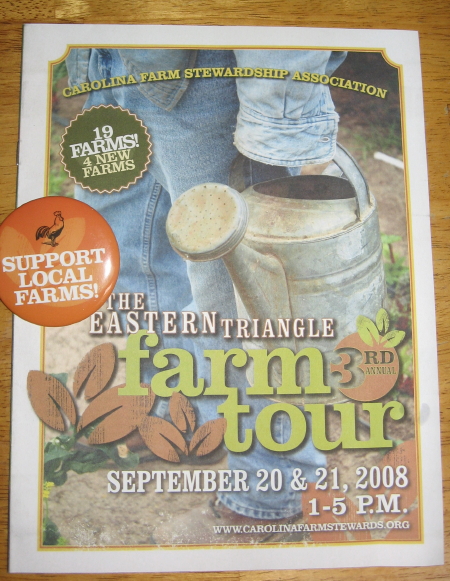
I posted at Raleigh Rambles about the Carolina Farm Stewardship’s  farm tour.  It was a fun couple of drives, and we saw plenty of nature to go along with the agriculture, as pictured below.

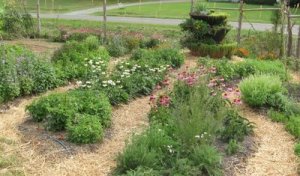
Above, a native plant area at the Piedmont Biofuel Lab Farm.  Below a large bird, perhaps a raven , that swooped down toward the highway for some time in front of us.  I suppose it’s probably a vulture, but it certainly didn’t act like one.

September 14, 2008

Visual Thoughts

Filed under: About & reflection, Exotica, Nature Lore — Tags: , , — raleighnaturalist @ 2:59 pm

Heavy Skies

Heavy Skies by D L Ennis at Visual Thoughts

 Looks like a painting, right?  But it is a photograph – not mine, of course, but an example of the amazing stuff over at Visual Thoughts, a fellow blog which doesn’t easily mesh with the other resources on my side bar but still belongs and is cherished on my blogroll.  D L Ennis posts about life and art and very much whatever, but if you’re in the mood or have a need to drink in a direct connection with nature, go to this unique blog: nature is there, coming through loud and clear.  Through some very artistic human eyes.

Looking Up

     Here is another image from Visual Thoughts.  The flower had ole D L stumped. Later, when I showed it to Cara she knew exactly what it was and went to look it up.  Meantime, I saw a comment by Jan had identified it as lycoris radiata, or red spider lily.  Cara knew it as outdoor amaryllis, for the single stem’s dramatic (and leafless) emergence.  We didn’t get to have the fun of informing D L , but I found Jan’s blog, which is lovely.  Just one of the wonderful things you may find at D L Ennis’s Visual Thoughts. Check it out!

« Newer PostsOlder Posts »

Blog at WordPress.com.